

Two weeks ago, I wrote about pairing Indian food with wine, and how many assumptions fall apart once you actually taste. This week I’m doing the same thing with a bubble.
There’s a Champagne you recognise, maybe a Prosecco, and an Italian bottle with a name you can’t place. Most of us order the Champagne because it feels safe, and I’m not judging, because I’ve done it too, many times. Living in Beaune, a few hours from Reims, it’s very easy to believe that serious sparkling wine stops at the French border.
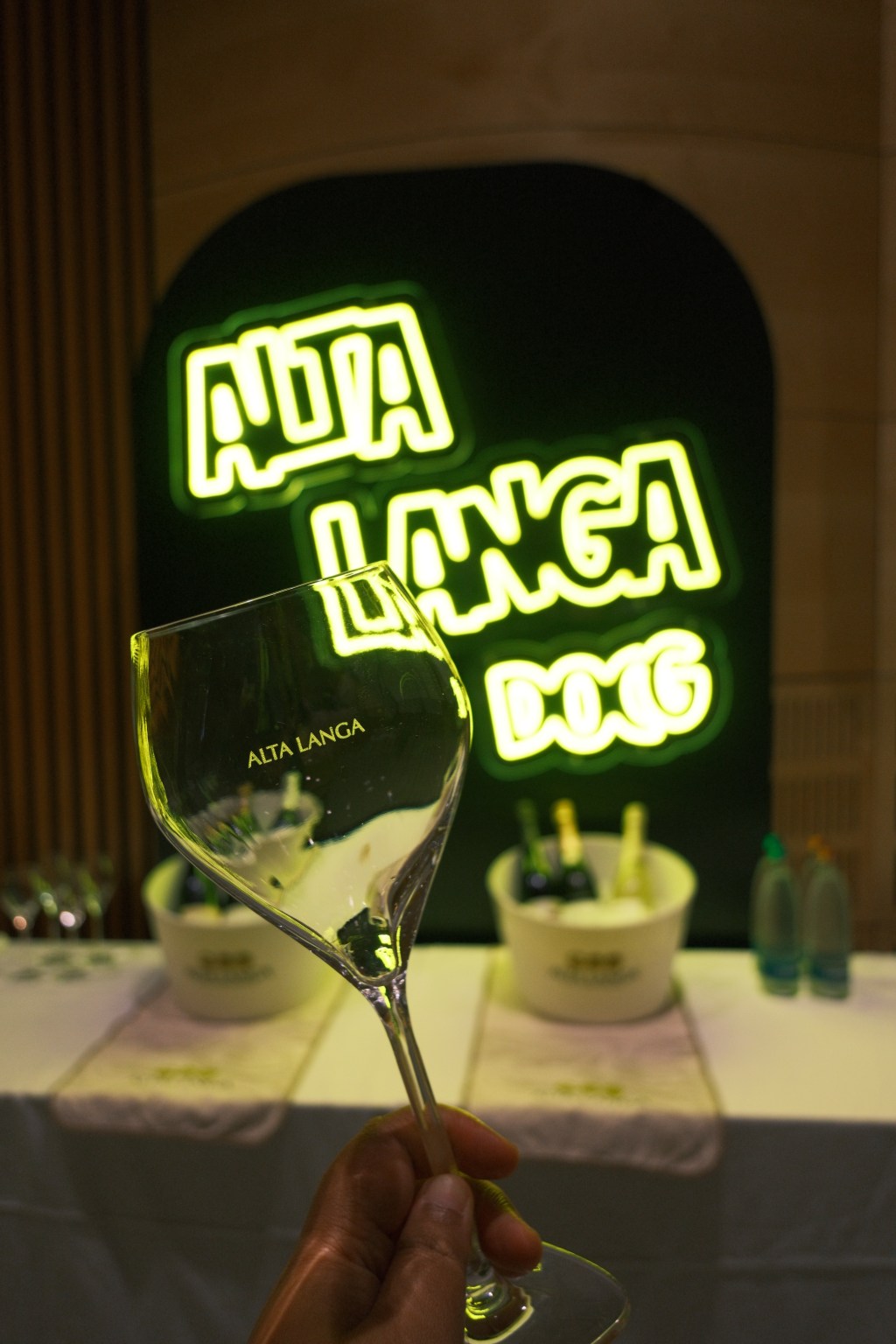
Then I spent three days in Alba and the hills around it, and by the end of it I had a notebook full of notes and a slightly bruised ego.
A Champagne recipe, carried home
The comparison with Champagne is where this story begins, so let’s deal with it first. Piedmont was making fizzy wine long before anyone here had heard of Reims. Between the 16th and 18th centuries the region was already known for effervescent wines, although the bubbles happened more or less by accident, with no real method behind them. The traditional method, with its second fermentation in bottle, riddling and disgorging, only arrived from France in the early 1800s.
The first serious attempt came from the royal family. In the 1830s Carlo Alberto of Savoy redeveloped the estate at Pollenzo with the aim of producing fine wine for the royal table, and the enologist General Paolo Francesco Staglieno ran trials of the traditional method there between 1838 and 1848. In 1846 the decision was made to dig a fully underground cellar for what was called the “King’s Champagne,” and by 1849 the cellar at Santa Vittoria d’Alba held 40,000 bottles in ageing. Cinzano, better known for vermouth, later took it over and turned it into one of the biggest sparkling centres in the province of Cuneo. Historians still argue about how much Staglieno actually achieved with sparkling wine, since his main focus was improving Piedmont’s reds.
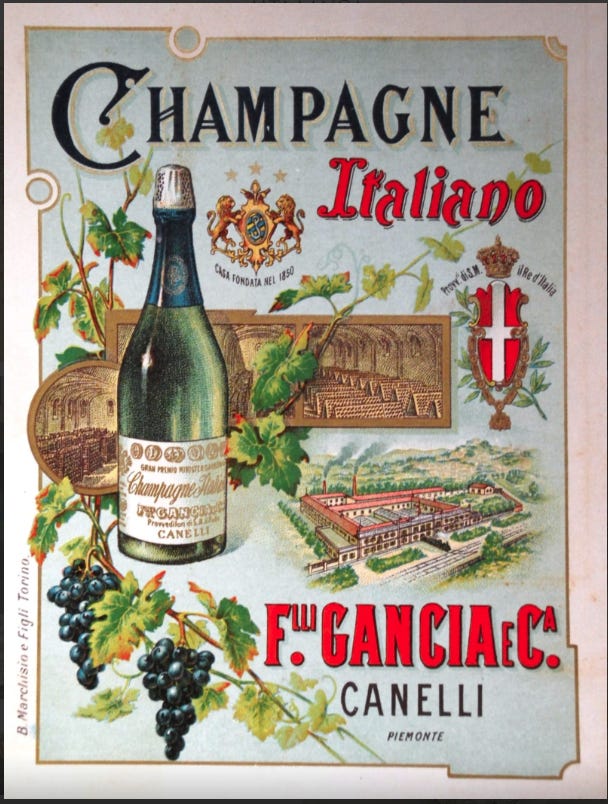
Then in 1848 Carlo Gancia, a young man from Narzole, travelled to Reims to learn how Champagne was made. He came home in 1850, founded Fratelli Gancia with his brother Edoardo in Chivasso, and after years of trials the company, by then in Canelli, released its sparkling wine in 1865. That wine was made from Moscato and became the ancestor of Asti Spumante, and its first exports left Italy by the end of 1866.
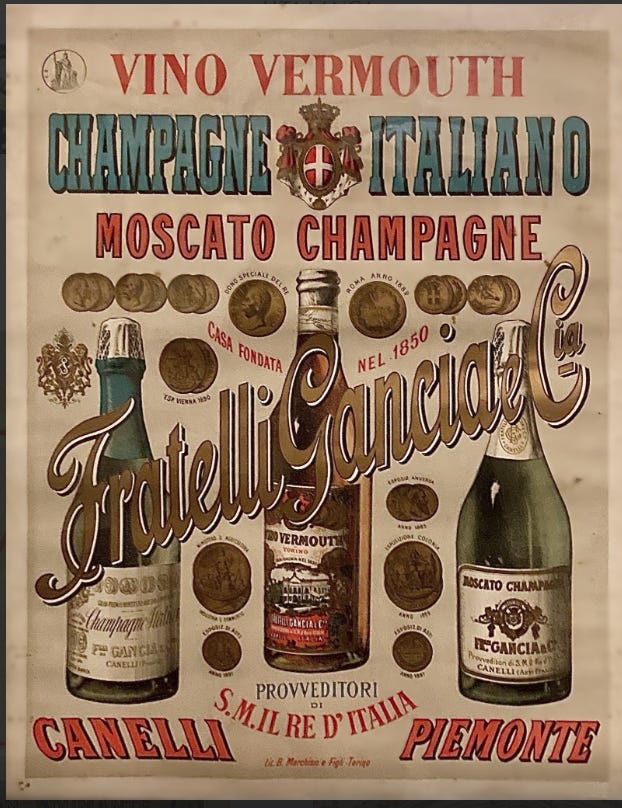
The part I find intriguing, is by the late 19th century, Canelli’s cellars were making two sparkling wines: a sweet “Moscato Champagne” and a dry “Champagne Italiano” made mainly from Pinot. According to research by Pierstefano Berta and Giusi Mainardi, Gancia encouraged growers around Canelli to plant Pinot and became the main buyer of Pinot grapes from the hills of Asti, Canelli and Neive. So the advertisement at the top of this piece was real, and the name came from the producers themselves. That wine was not Alta Langa as we know it today, and Italian wine writers still argue over whether the first Italian metodo classico was an Asti or an ancestor of Alta Langa. As a wine educator I love a good origin fight, but the detail that matters to me is simpler: Pinot was already growing in these hills, and Piedmont was already dreaming of Champagne.
By the end of the 19th century Piedmont was known for its sparkling wine, and its producers were supplying the Royal House of Savoy for court luncheons. You will never see “Champagne Italiano” on a label today, though, because the word Champagne is legally protected and belongs only to wine from Champagne.
Why Piedmont speaks a little French
For centuries Piedmont looked west as much as it looked south. It was ruled by the House of Savoy, whose original duchy across the Alps used French as its official language from the 15th century. The dukes only moved their capital from Chambéry to Turin in 1563, and they brought their French-speaking court culture with them. Turin’s Palazzo Madama takes its name from the “Madama Reale,” Christine of France, daughter of Henri IV, who ruled as regent from 1638 to 1648.
Then came Napoleon. His armies took Piedmont in 1796, and in 1802 it was annexed to France outright. For more than a decade the people of Turin lived under the Code Napoléon and French administration, and the local aristocracy partied at the court of Pauline Bonaparte and her husband Prince Camillo Borghese, the French governor in Turin.
You can still hear all of this today. Piemontese, the regional language spoken by around two million people, has a closed “u” pronounced exactly like the French one, and its “eu” sound comes straight from French. “Feu” means fire in both languages. A gentleman is “monsù,” from monsieur, a lady is “madama,” and today is “ancheuj,” which sounds much closer to aujourd’hui than to the Italian oggi. If you speak French every day, written Piemontese looks strangely familiar. Linguists describe the French influence on its vocabulary and expressions as very strong, and modern efforts to revive the language still borrow French-style words.
Underground cathedrals
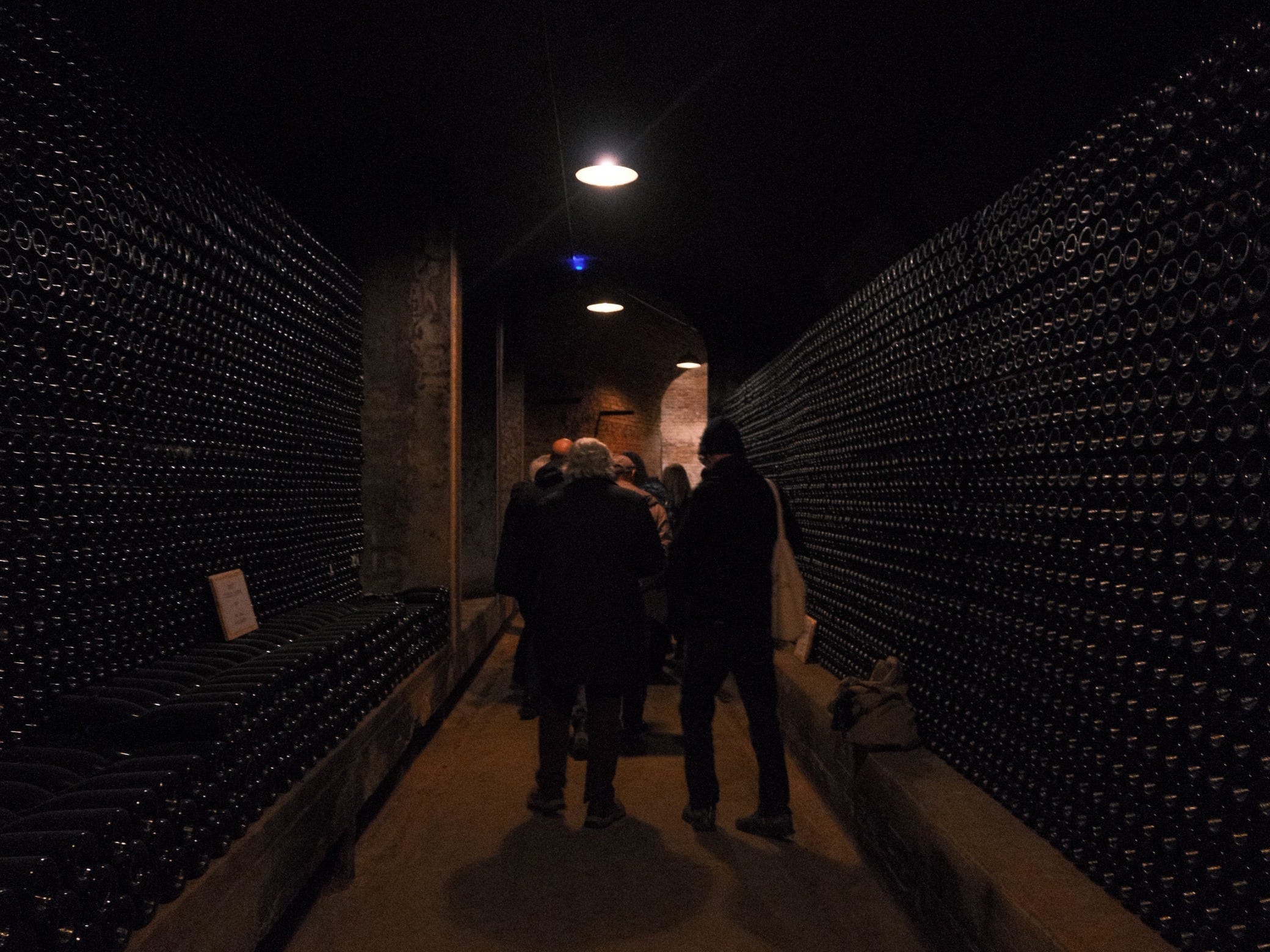
On our second day of visit, we went underground in Canelli, the town known as the capital of Italian sparkling wine. Beneath its hill run the “Cattedrali Sotterranee,” the Underground Cathedrals: long tunnels and galleries dug into the tuff between the 16th and 19th centuries, some more than 32 metres below the surface. Four historic houses own them today, Bosca, Contratto, Gancia and Coppo, and all four open them to visitors. In 2014 UNESCO listed them as part of the Vineyard Landscape of Piedmont: Langhe-Roero and Monferrato, with Canelli recognised for its role in the history of Asti Spumante.
We visited Coppo. Piero Coppo founded the winery in 1892, and his marriage to Clelia Pennone, heir to an old family of cellar owners, helped him expand. The family took over the famous cellars in 1913, and today they spread over about 5,000 square metres and reach 40 metres deep. Piero was among the early producers in Canelli to make sparkling wine with a second fermentation in bottle. Four generations later, Coppo’s Riserva 2010 was the first vintage of that wine released under the Alta Langa DOCG, and the range now includes a Brut named after Luigi Coppo, a Pas Dosé, a Riserva Extra Brut and a rosé called Clelia, after the woman whose cellars started it all.
The name makes complete sense once you’re inside. You walk under barrel-vaulted brick ceilings in cool, still air, with thousands of bottles resting in the dark. The temperature underground barely changes through the year, a great thing as the wine needs when it has to sit on its lees for 30 months or more before anyone opens it.
So what is Alta Langa?
Alta Langa is much younger than the cellars. On 28 February 1990, seven Piedmontese sparkling houses, often called the “seven sisters,” committed to analysing soils and testing Pinot Noir and Chardonnay on the high hills: Cinzano, Contratto, Fontanafredda, Gancia, Martini & Rossi, Riccadonna and Vini Banfi. They handed the research to Italy’s Experimental Institute for Viticulture, which spent two decades testing Pinot Noir clones across different parts of the Langa and Monferrato, and the first trial vines went in around 1994. The name Alta Langa was chosen in 1998, the first toast was raised in Bossolasco in May 1999, the consortium was founded in 2001, the wine became a DOC in 2002 and it was promoted to DOCG in 2011, backdated to the 2008 vintage.
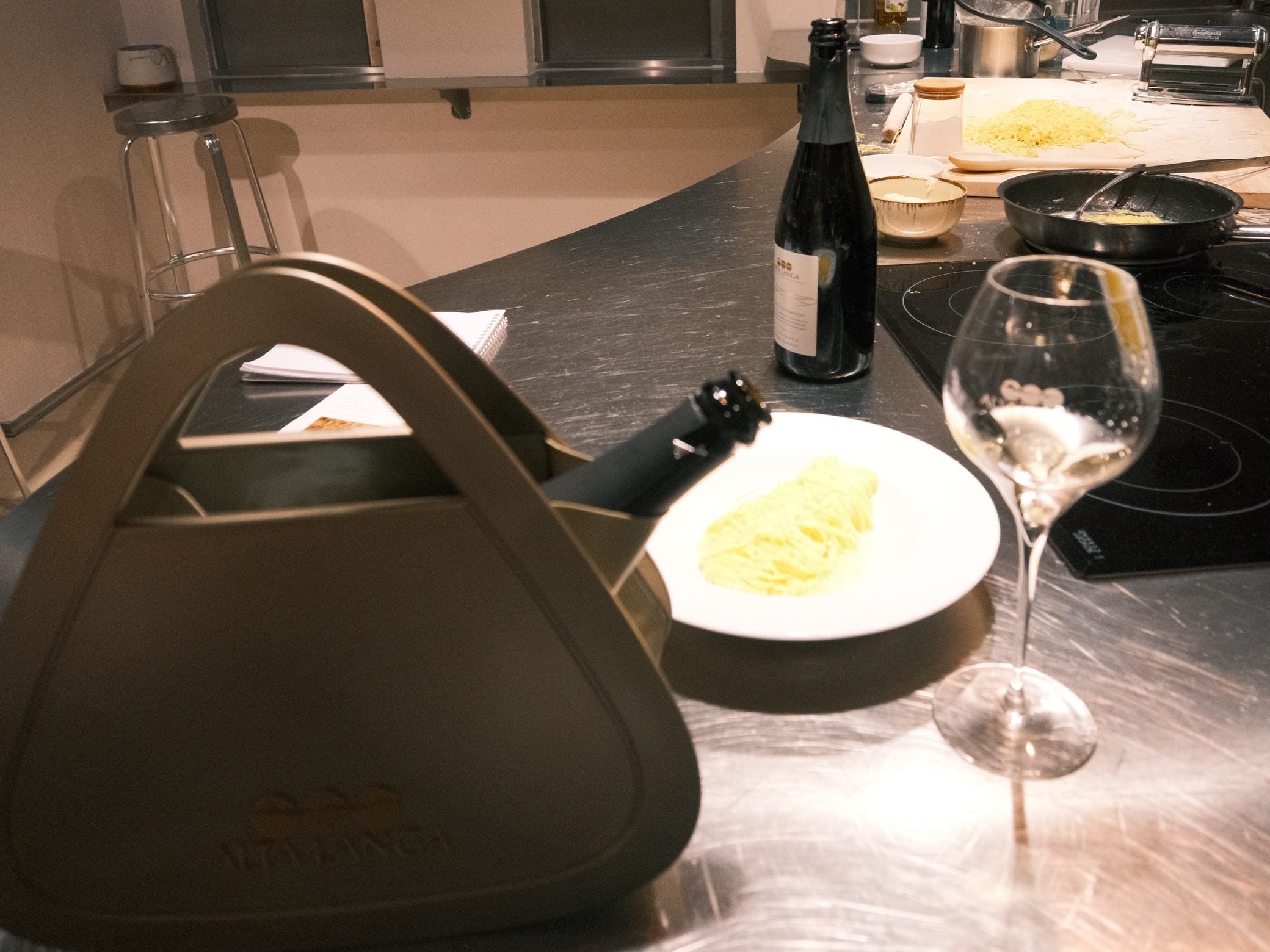
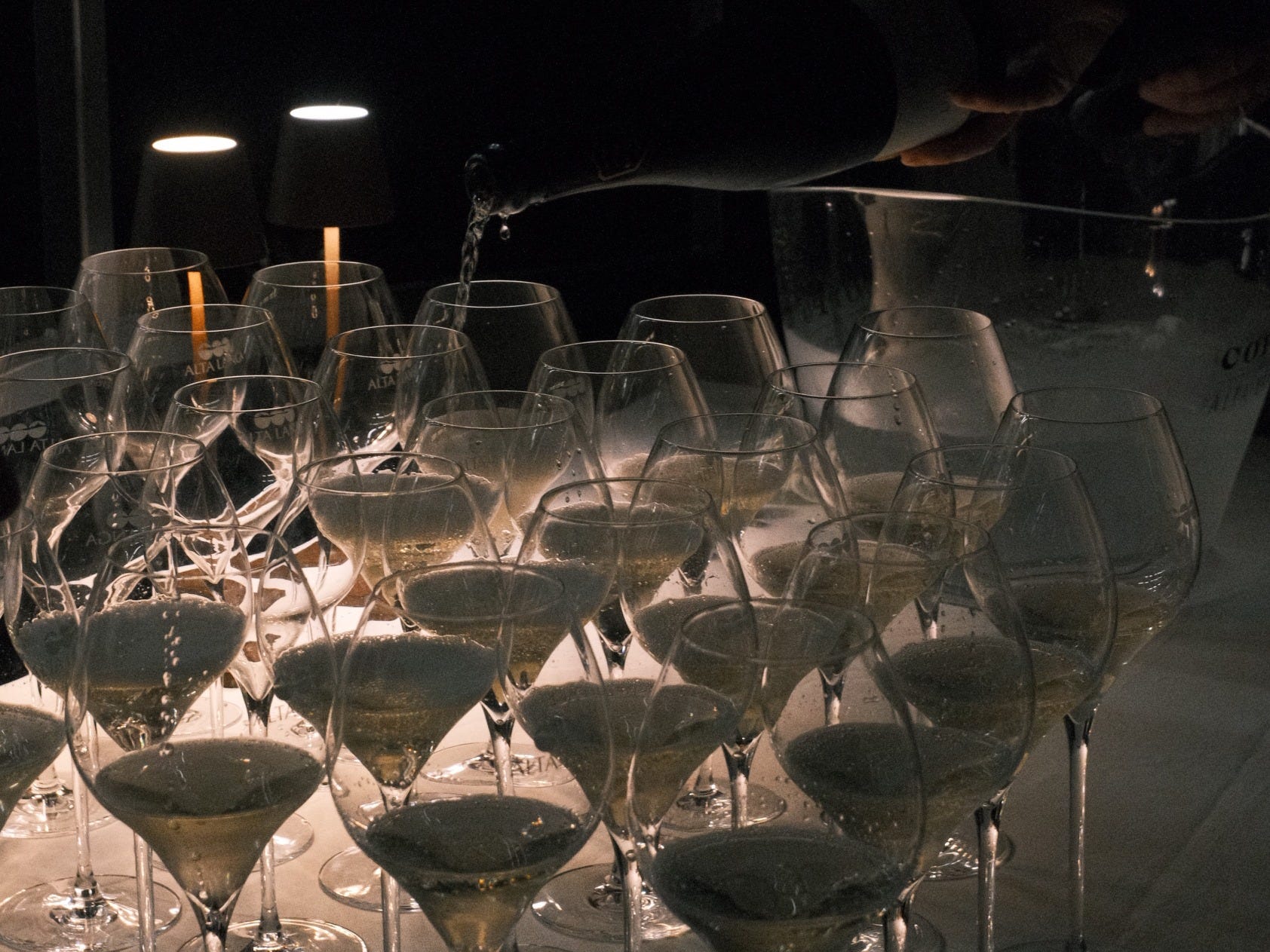
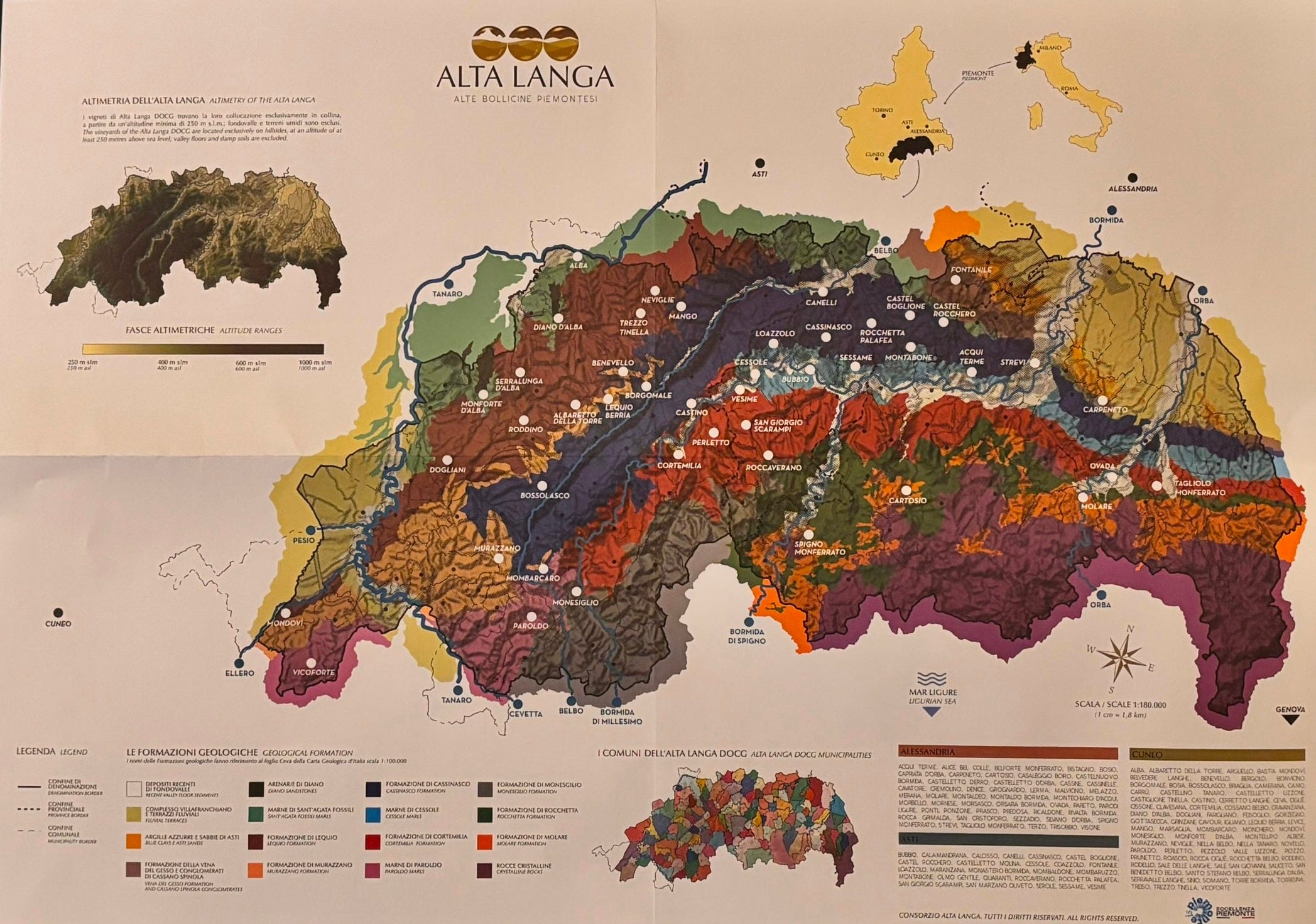
Today it covers 149 villages across the provinces of Asti, Alessandria and Cuneo, on the right bank of the Tanaro river. The rules are strict, and honestly they are what make the wine interesting:
- Always vintage. Every bottle carries its year, so you’re tasting one harvest rather than a house blend built to taste the same every year. Vintage is the exception in Champagne, and here it is the law.
- At least 30 months on the lees, counted from the start of the second fermentation, and at least 36 months for a Riserva.
- Traditional method only, with every step from winemaking to bottling and ageing done in Piedmont.
- Hillside vineyards only. Vineyards must sit at a minimum of 250 metres, and damp valley floors and flat land are banned. The highest sites climb above 800 metres.
- The grapes are Pinot Noir and Chardonnay, which must make up 90 to 100% of the blend, with up to 10% of other non-aromatic varieties allowed, Nebbiolo being the main one. Producers told us the overall split is roughly two-thirds Pinot Noir to one-third Chardonnay.
- Picked by hand into small perforated crates, then pressed gently in pneumatic presses, with no more than 65% of the grape weight allowed to become wine.
- White or rosé, and dry. Demi-sec, sec and dolce styles are not allowed.
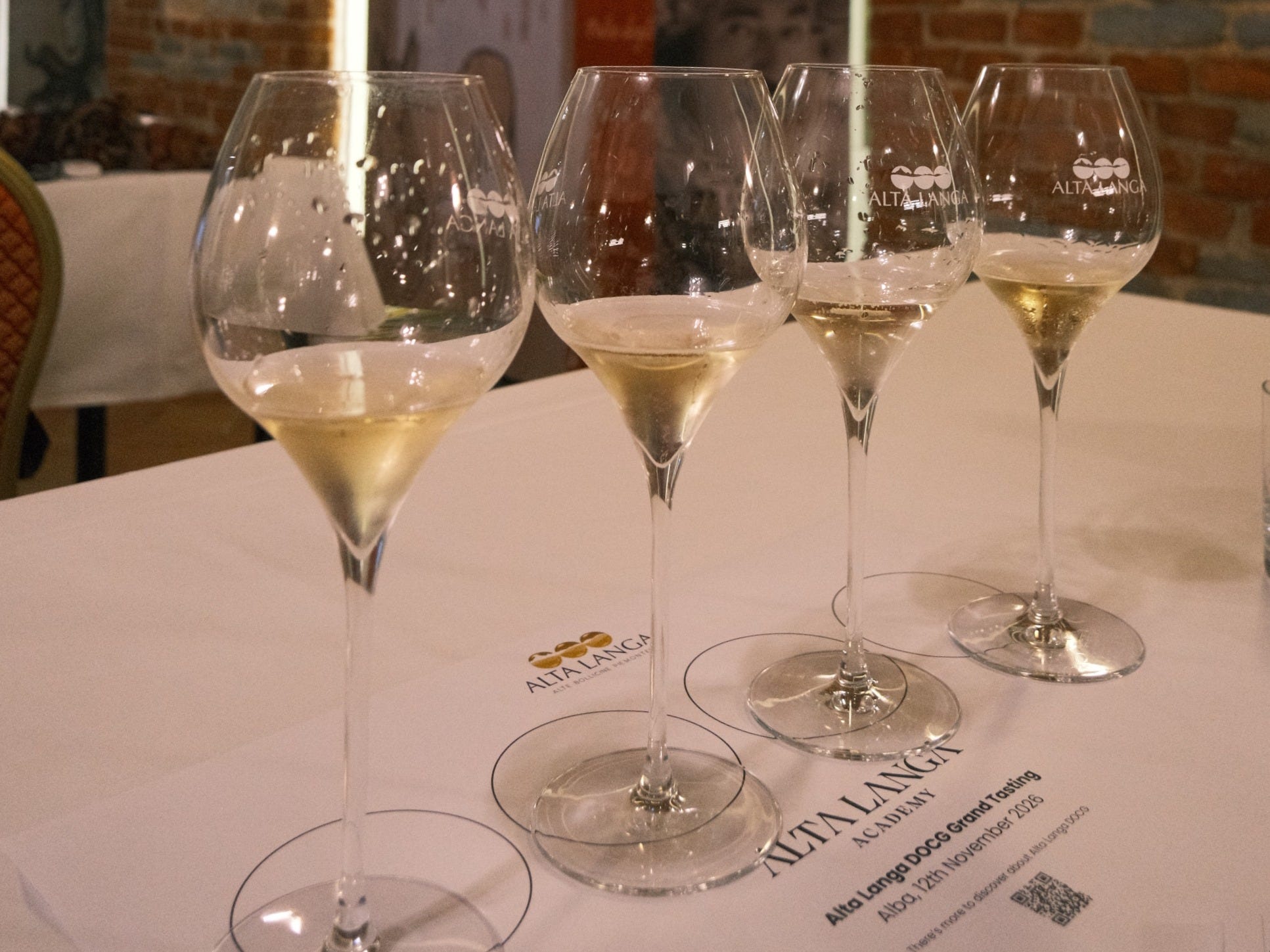
If you’re wondering how Pinot Noir, a red grape, ends up in a pale golden wine: the juice of most red grapes is clear, and the colour sits in the skins. Press the grapes gently and separate the juice from the skins quickly, and you get a white wine. Leave them in contact a little longer and you get rosé. That 65% pressing limit matters here, because the first, gentlest juice picks up less colour and bitterness from the skins, which is what you want in a fine sparkling wine.
Reading the soil in the rain
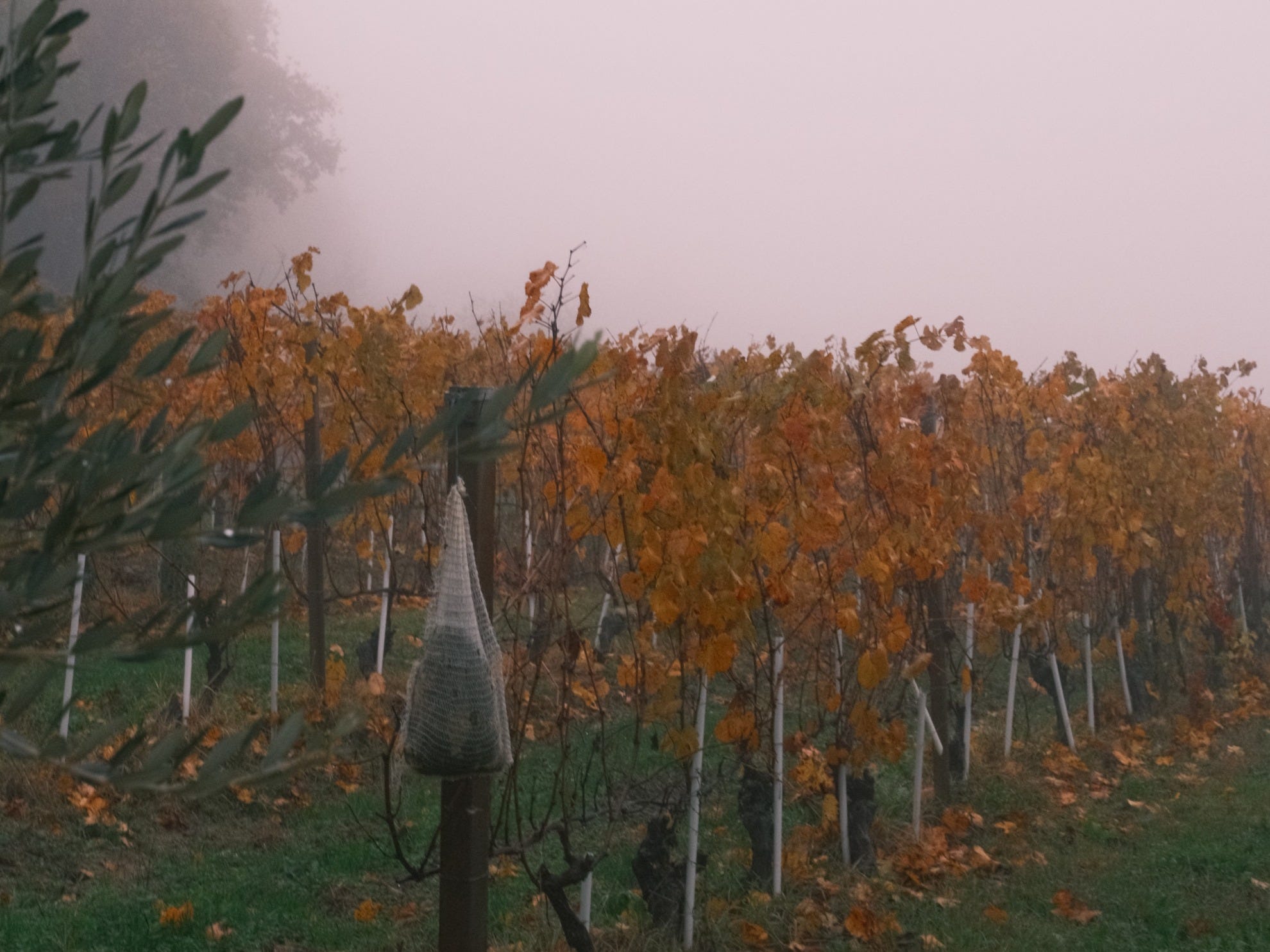
On our vineyard day it poured, which honestly suited the subject. Agronomist Edmondo Bonelli walked us through what’s under our feet, and the story starts underwater. Between roughly 12 and 5 million years ago, during the Miocene, this part of southern Piedmont was the floor of a sea that geologists call the Tertiary Piedmont Basin. Sediment settled on that seabed layer by layer and hardened into the rocks you see today: calcareous clays, marls, sands and sandstones. The hardest sandstone layers are what locals call “pietra di Langa,” the Langa stone you find in old dry-stone walls and farmhouses all over these hills.
Geologists split these layers into formations, many named after the villages where they were first studied. The Lequio Formation alternates sand and marl, which gives soils rich in silt, clay and limestone. The Murazzano Formation, found at the highest elevations, is made of marls very rich in limestone with thin layers of fine sand. The Alta Langa rules describe the ideal vineyard soil as a moderately fertile calcareous clay marl, which fits that picture neatly.
Coming from Bourgogne (Burgundy), our Pinot Noir and Chardonnay grow on limestone and marl too, although ours were laid down in a much older Jurassic sea, and Champagne sits on chalk from another era again. Calcareous soil seems to be the common thread behind elegant, high-acid Pinot and Chardonnay, and the Piedmontese versions are younger, sandier and more varied from one hill to the next.
Then there is altitude. Bonelli has said the average vineyard sits at around 450 metres, with the highest close to 900. The high Langa was traditionally a land of woods, goats and hazelnuts, and until the 1980s you could even ski up here. Cooler nights slow ripening, so the grapes keep their acidity, which is exactly what a sparkling wine needs to age gracefully for years on its lees. Producers also told us how much the cold helps them protect biodiversity and farm in an organic, sustainable way. With summers getting hotter every year, I think these hills will matter more and more.
So, can I call it Italian Champagne?
No, and I don’t think it needs to borrow that name anymore. Calling it “Italian Champagne” makes Alta Langa sound like a copy, and it isn’t one. It started with a Champagne method brought home from Reims, then spent more than a century becoming its own thing: higher, colder, always vintage, grown on an ancient seabed.
I left Piedmont with learning something new about this region, what stayed with me most, though, was the patience in every bottle. Someone plants vines on a cold hillside, waits years for them to give good fruit, then waits at least another 30 months before anyone is allowed to open the wine. That kind of patience deserves better than being measured against somebody else’s region.
Alta Langa began with a young man bringing home what he learned in Reims, and it has grown into something with an accent of its own, much like Piemontese kept its French vowels and still sounds entirely like Piedmont. So no, I won’t call it Italian Champagne. I’ll call it Alta Langa, and the next time you spot that name on a wine list, I hope you give it the chance it gave me!
Sources
- Consorzio Alta Langa, “History.”
- Consorzio Alta Langa, “The production area and the vineyard.”
- Consorzio Alta Langa, “The production regulations.”
- Consorzio Asti DOCG, “History.”
- Wine Folly Asti Guide, “Gancia.”
- University of Gastronomic Sciences (UNISG), “The Noble Origins of Piedmontese Sparkling Wines.”
- Dissapore, “L’Alta Langa riscrive la storia del vino, è lui il primo Metodo Classico italiano. O no?”
- L. Corino, M.R. Lottero, G. Malerba, “Progetto Tradizione Spumante in Piemonte: verifica di selezioni clonali di Pinot nero, 1992 to 2012,” CRA-ENO.
- MuseoTorino, Turin: A History, timeline and chapter VI (Napoleonic Turin).
- Wikipedia, “Savoy” and “Italian irredentism in Savoy.”
- Cacia, CILPR 2013 proceedings, on Palazzo Madama and the Madama Reale.
- Bertola, “Piemontèis pronunciation.”
- Areq.net, “Piémontais” (comparative vocabulary).
- Mauro Tosco, “Swinging back the pendulum: French morphology and de-Italianization in Piedmontese,” De Gruyter.
- Touring Club Italiano, “Le Cattedrali Sotterranee: l’unicità di Canelli”; FIRSTonline, “Monferrato, alla scoperta delle Cattedrali sotterranee di Canelli.”
- Vino.com, “Coppo”; Langhe.net, “Coppo Historic Cellars”; The Grand Wine Tour, “Riserva Coppo 2010.”
- Langhe Vini, “Climate and Geology”; Alessandro Masnaghetti, Barolo MGA (excerpt, Vinous).
- Gambero Rosso, “Alta Langa metodo classico.”
- Italy Segreta, “Alta Langa, il nuovo marchio del territorio.”
- Alta Langa DOCG seminar, Alba, 12 November 2026 (author’s notes).


Leave a Reply