

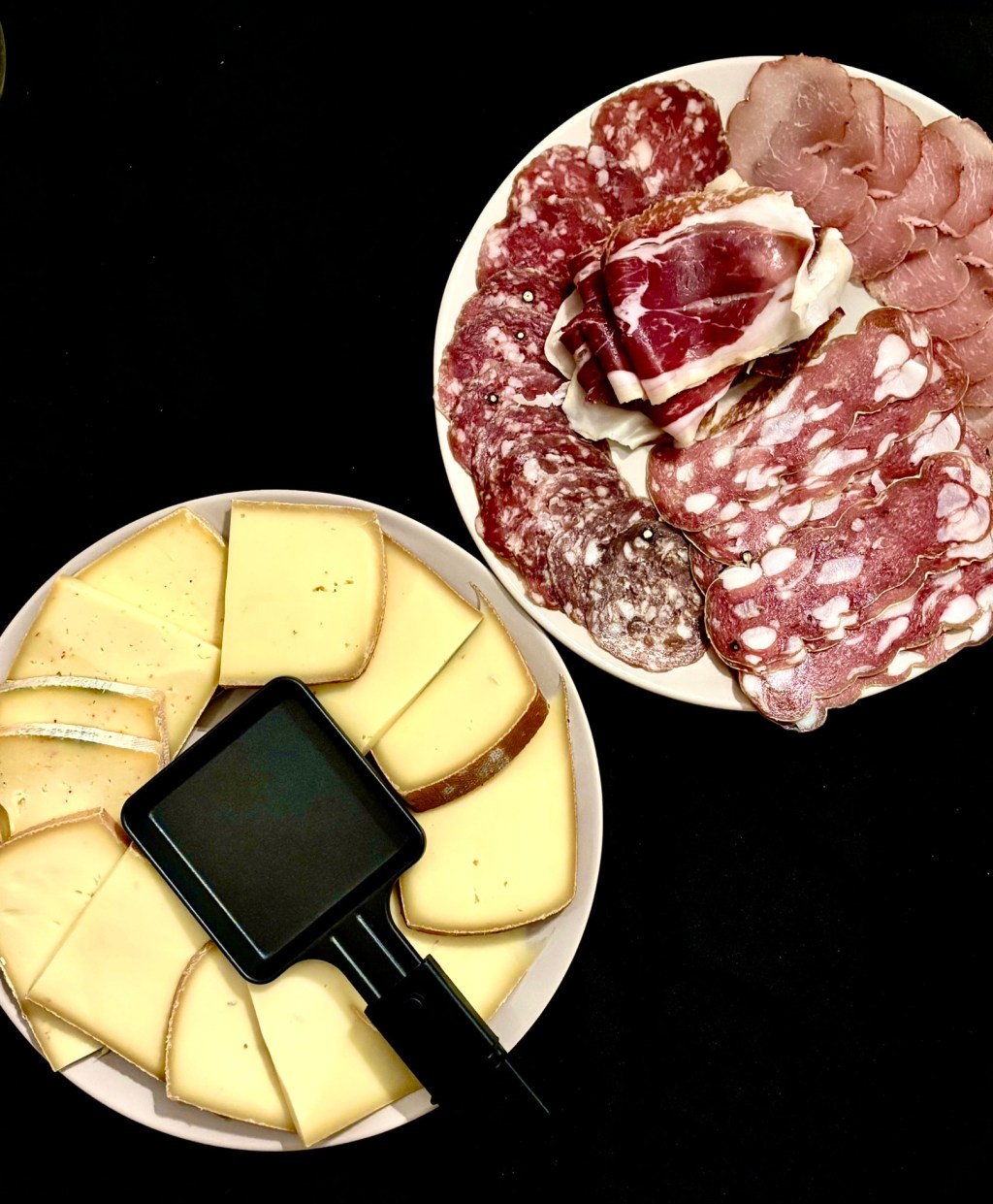
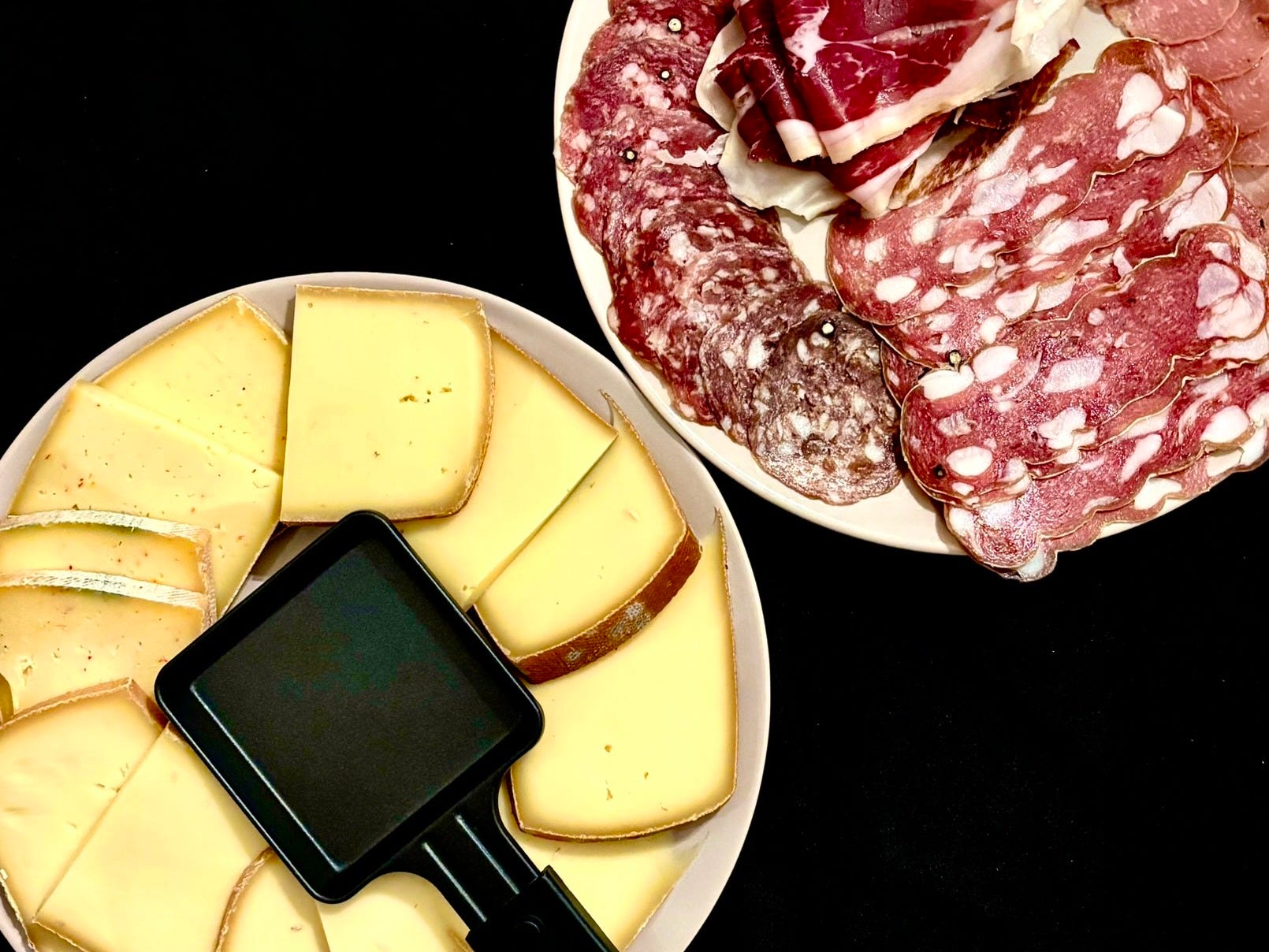
It is November in Beaune, which means the raclette machine has come out of the cupboard and nobody in this house is pretending otherwise. There is a wheel of cheese melting under the grill, a bowl of steaming potatoes, cornichons, a few slices of jambon cru, and a bottle of something white and sharp on the table. I take a photo, because of course I do, and I send it to the family WhatsApp group, my mother video calls me, squints at the screen and asks the question I knew was coming: “That’s it? When are you going to eat your actual food?”
If you grew up in a South Asian household, you already know this conversation by heart. A meal, in the grammar our parents taught us, has a centre. That centre is rice or roti, paratha or naan, and everything else on the plate is there to help you eat it. Cheese and potatoes, no matter how much of them you eat and how warm you feel afterwards, read to them as a snack that got ambitious. A sandwich is a snack. Pasta is a snack and a baguette, somehow, despite being literally bread, does not count as bread, because it is not the bread.
I laughed it off on the call. Then I did what I always do when something makes me laugh and itch at the same time: I went looking for the history. It turns out my parents are not being dramatic, or at least not only dramatic. They are speaking a food language that half of Asia shares, that anthropologists have a name for.
When the word for rice is the word for meal
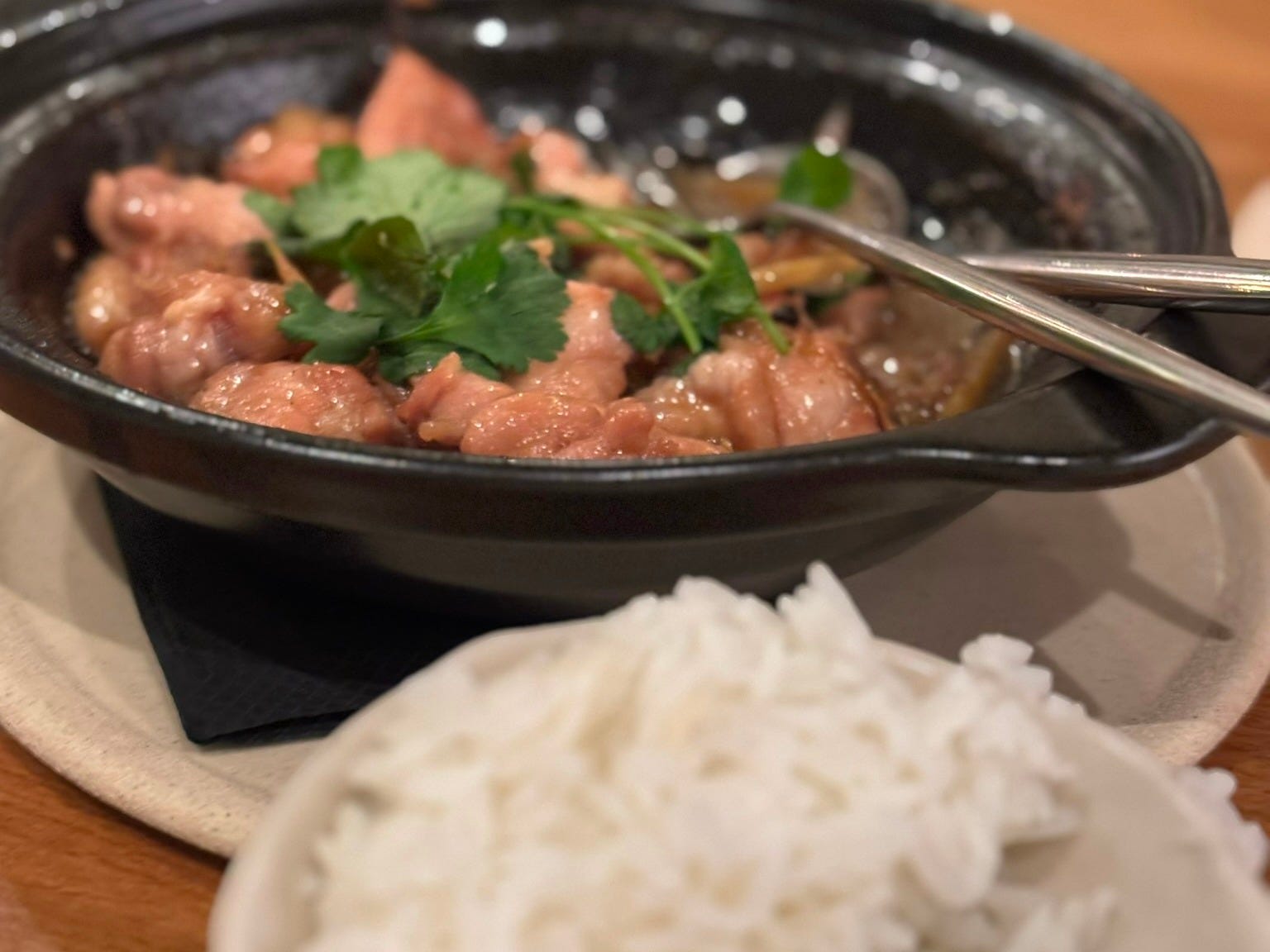
In Japanese, gohan is cooked rice, and gohan is also a meal. Breakfast is asa-gohan, lunch is hiru-gohan, dinner is ban-gohan, which means a Japanese person technically eats “morning rice” even on the days they have toast. The classic home meal structure, ichiju sansai, translates as one soup and three dishes, and the three dishes are called okazu, foods that accompany rice. Rice is not even counted among the three, because it is the floor the whole meal stands on.
Korea does the same thing with even more feeling. Bap is cooked rice, and bap is a meal, so the everyday greeting “bap meogeosseo?” asks whether you have eaten rice when it really asks how you are. You can eat pasta for lunch in Seoul and still say you had your bap. Koreans will also say “let’s eat bap sometime” when they mean let’s meet, which is the most Asian way possible of saying I care about you without saying it.
China has the most formal version of this logic. The archaeologist K.C. Chang described the Chinese meal as built on two halves: fan, meaning grains and starches, and cai, meaning the vegetable and meat dishes. A balanced meal needs both, but they are not equal. Scholars of the Chinese diet point out that fan is treated as the main part of the meal and is often used to mean food in general; without fan, the diner is considered still hungry, and without cai, the meal is merely less tasty. Fuchsia Dunlop puts it beautifully: all the dishes, however extravagant, exist to help “send the rice down”. Mandarin speakers greet each other with “chi fan le ma?”, have you eaten rice, in exactly the same spirit as the Koreans.
In Bengali, “bhaat kheyecho?” (have you eaten rice?) is the polite way of asking whether someone has had lunch or dinner, and the older words anna and odan meant both rice and meal.
Thai and Vietnamese speakers ask the same question with their own word for rice. Across a huge part of Asia, eating and eating rice are linguistically the same act. So when my mother sees a plate of melted cheese and asks when I am going to eat, she is being grammatically correct.
When the word for bread is the word for life
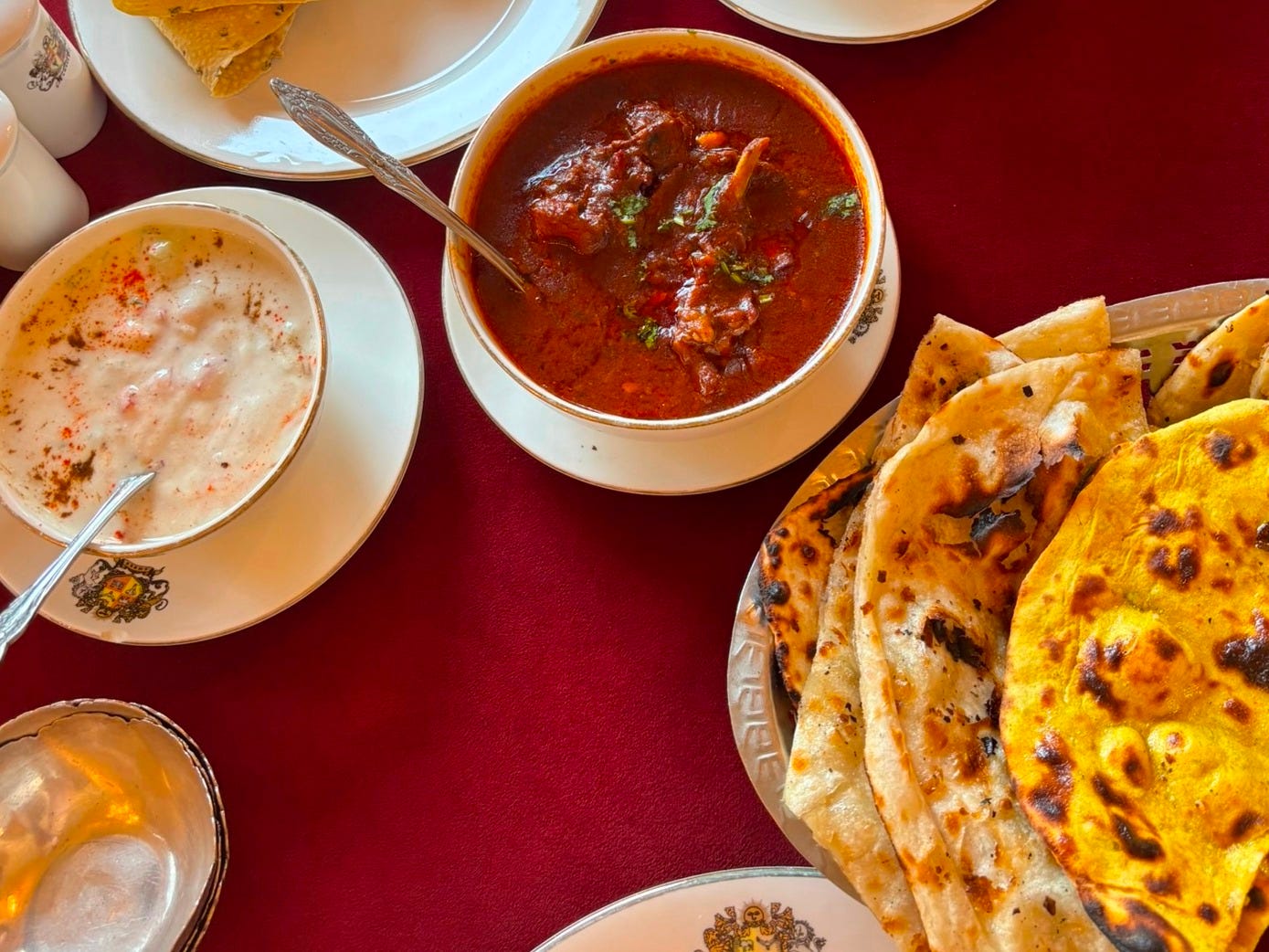
Move west and the rice turns into bread, but the logic stays exactly where it was. In North India, roti is shorthand for survival itself. We say someone is working for “do waqt ki roti”, bread for two meals a day, and the most famous political slogan of the 1970s, “roti, kapda aur makaan”, put bread before clothes and a roof.
In Iran, nan is a Persian word in use since the Achaemenid empire, and bread is the staple everywhere except around the Caspian, where rice takes over. In modern Iran, bread is still the everyday staple for most of the population. The language follows because the breadwinner of a family is the nan-avar, the one who brings the bread, and to earn a living is literally to bring out bread. Bread is treated as barakat, a blessing, and Maryam Zandi recalls that letting it fall to the floor or throwing it away was considered a sin when she was growing up.
In Central Asia the same word becomes non, a cognate of the naan we know in South Asia, and wheat itself carried religious weight in Zoroastrianism, which first took root in the region. In Uzbekistan, bread should never be placed upside down, is torn by hand rather than cut with a knife, and is shared. When a son leaves for military service, he bites a piece of non and the family hangs the rest up until he comes home safely to finish it.
Here is the part my parents will not enjoy hearing: France was once exactly like this. In the fifteenth and sixteenth centuries, the average French person ate somewhere between about 700 g and 1.1 kg of bread a day, and for the poor it was most of the diet. By the eighteenth century, town workers typically spent around half their wages on bread, and when harvests failed and grain prices rose, the result was riots, including the Flour War of 1775. The French still say “gagner son pain”, to earn one’s bread.
So why does a meal need a centre?
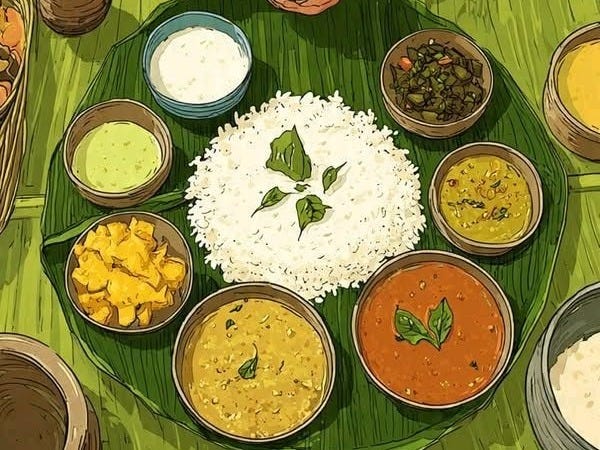
The anthropologist Sidney Mintz gave this pattern a name. Together with the nutritionist Daniela Schlettwein-Gsell, he described what he called the core-fringe-legume pattern of agrarian societies. The core is a bland, filling complex carbohydrate: rice, wheat, millet, maize, cassava. The fringe is everything that makes the core exciting to eat, the pickles, sauces, chutneys, spices and relishes, and a legume, usually some kind of dal or bean, sits beside them. Dal, rice and achaar is practically a textbook illustration. So are Mexican beans and tortillas, Japanese rice with miso, and West African fufu with its soup.
The logic is economic before it is emotional. For most of human history, most people could not afford much meat or cheese, so the bulk of every meal came from the cheapest thing that grew in quantity locally. You eat a lot of the core because it is what keeps you alive, and you eat a little of the fringe because it is what makes the core go down. Over centuries, that habit stops being a budget and becomes a definition. The core is the meal, and everything else is the fun part.
Then add memory, which is where our parents come in. The generation that raised us in India grew up in or just after a period when the country was described as living “ship to mouth”, dependent on American wheat shipped under the PL-480 programme. In 1965, in the middle of war and drought, Prime Minister Lal Bahadur Shastri asked Indians to skip one meal a week so the grain could stretch further. Many families actually did it. When a whole generation learns that the first thing to disappear in a crisis is the grain, the grain becomes the thing you check for. A child who has eaten rice or roti has eaten. A child who has eaten cheese has, at best, been distracted.
This is also why fullness means something specific in our homes. “Pet bhara?” is a moral question as much as a physical one, and our parents measure it in starch because starch was the unit of safety. When my mother looks at a raclette and asks how my stomach will be full, she is not really asking about cheese. She is asking whether I am safe, is what I have learnt.
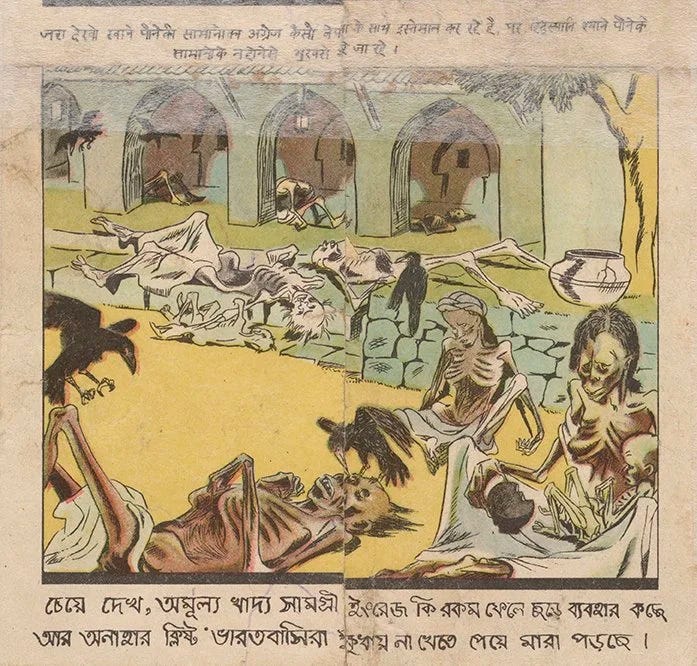
Phan dao: the famine behind the question
For Bengalis, the question “have you eaten rice?” carries a much heavier memory. In 1943, in the middle of the Second World War, Bengal went through one of the deadliest famines of the twentieth century. Estimates of the dead vary widely, and Amartya Sen’s widely quoted figure is around three million. Japan’s occupation of Burma cut off the rice imports Bengal had relied on, and the colonial government’s “denial policy” removed surplus rice and seized or destroyed boats in the coastal districts so they could not be used by an invading Japanese army. In a delta where boats moved rice, fish and people, that alone wrecked livelihoods. The government’s own Famine Inquiry Commission found that rice prices rose to five or six times their level in early 1942. Sen later argued that Bengal did not run out of rice so much as millions of people lost the ability to buy it.
Starving families walked into Calcutta from the villages. Eyewitnesses still remember the cry of “phan dao”, give us the starch water, the cloudy water poured off after boiling rice; people were begging for that, not even for the rice itself. On 22 August 1943, The Statesman newspaper in Calcutta published photographs of the dying on its streets, and the famine finally became international news. In Bengali it is remembered as Panchasher Monnontor, the famine of the Bengali year 1350, and Satyajit Ray later turned it into Ashani Sanket (Distant Thunder).
The Famine Inquiry Commission itself described Bengal as a land of rice growers and rice eaters. When the rice went, everything went. That is the history sitting quietly behind every Bengali mother who adds a second helping of bhaat to your plate before you have finished the first. I do not think my mother consciously thinks of 1943 when she looks at my raclette, but the reflex of checking for rice was built by people who had every reason to check, and reflexes are passed down long after the reason is forgotten.
What is France’s dal chawal?
One evening I asked Monsieur a question, “What is your dal chawal? The thing you eat when you are tired, broke, sick, or just home. The food nobody photographs.” An omelette, he said, or potatoes with something. Pommes de terre sautées, a gratin, purée with a bit of ham, an omelette with potatoes folded in if you are feeling fancy. Then he looked at me as if the answer were obvious, which, to him, it was.
That answer is more historical than he realised. The potato is a relatively recent French comfort. In the eighteenth century it was widely treated as animal fodder, and popular legend says France banned it outright, though historians have found no evidence of an actual ban. What we do know is that Antoine-Augustin Parmentier, a pharmacist who survived on potatoes as a prisoner of war in Prussia, spent years campaigning for them; the Paris Faculty of Medicine declared potatoes edible in 1772, and the bad harvest of 1785 finally made people take them seriously when they kept the north of France from famine. A famine food became a comfort food, which is exactly how most cores are born. Bengal, funnily enough, was adopting the same tuber around the same period: aloo bhate, mashed potato eaten with rice, only joined the Bengali plate after the Portuguese introduced potatoes.
Now look at raclette with that in mind. Swiss records mention a roasted cheese called Bratchäs in convent manuscripts from Obwalden and Nidwalden as far back as 1291, valued as a nourishing food for alpine herdsmen, and the first written account of melting cheese by the fire in Valais dates to 1574. The dish takes its name from the French racler, to scrape, and the traditional Valais way to eat it is with boiled potatoes, cornichons and pickled onions. The word raclette has been in common use for the dish since 1875, and it was promoted as the national dish of Valais at the 1909 cantonal exhibition in Sion.
In France, most homes use an appareil à raclette, the electric machine with small individual pans called coupelles, which the Savoie company Tefal helped popularise in the 1970s. Everyone slides a slice of cheese into their own coupelle, waits for it to bubble, then scrapes it over the boiled potatoes on their plate. The French version adds charcuterie, so you will see Bayonne ham, cooked ham and rosette de Lyon on the table next to the cornichons and pickled onions. The cheese itself, Raclette de Savoie, has had IGP protection since 2017, and there is a genuine national argument about whether you eat the rind or cut it off. There are no courses and nobody is in a hurry. Everyone builds their own plate, round after round, for a whole evening, which is honestly the closest thing France has to a family sitting around a thali.
How I am explaining raclette to my parents
Every culture builds its plate around something cheap, filling and local, then wraps that something in so much love and memory that people from other cultures cannot see it as food at all, so that would be my answer.
I also think it is worth saying out loud that “is your stomach full?” is one of the most loving questions in any language. Our parents ask it in rice and roti because those were the foods that stood between their families and hunger. The Koreans ask it in bap, the Iranians in nan, and the French, I would argue, ask it in potatoes. My mother does not actually need to understand raclette. She needs to know I am fed. I can give her that without converting either of us hehehe.
Sources
- Mintz, S. and Schlettwein-Gsell, D. (2001). “Food Patterns in Agrarian Societies: The Core-Fringe-Legume Hypothesis.” Gastronomica 1(3): 40-52. Referenced in Food and Foodways
- Rice in Japanese: Kome, Gohan, Meshi, This Is Japan
- Ichiju Sansai, Just One Cookbook
- Korea in ten words: Rice, The Korea Times
- Chang, K.C. (ed.) (1977). Food in Chinese Culture, Yale University Press, excerpt via Asia Society
- Changing Rice Bowl: Economic Development and Diet in China, Hong Kong University Press, via Project MUSE
- Invitation to a Banquet by Fuchsia Dunlop (review), Asian Review of Books
- Bengal’s forgotten rice varieties, Scroll.in
- Zandi, M. Breads, via ckbk
- Bread (Persian nan), Encyclopaedia Iranica
- Majlesi, A. Glimpses of bread making in Iran, Tehran Times, 2021
- Uzbekistan: Fabled non flatbread endures along the old Silk Road, Middle East Eye
- Sacred staple: Uzbekistan’s timeless tradition of everyday bread, Arab News, 2025
- Bread and the sieges of Paris, Atlas Obscura
- Flour War, EBSCO Research Starters
- Goldstein, D. Recipes for Sidney Mintz, sidneymintz.net
- The real story of the Green Revolution, ThePrint
- Lal Bahadur: Fiat car, carpet and other stories about him, The Pioneer, 2013
- Antoine-Augustin Parmentier, Wikipedia
- Raclette, Wikipedia
- Raclette: the Swiss national dish, Lusini
- Raclette 101, The Cheese Professor
- What’s Cooking? An Ode to Panta Bhat, LiveWire, The Wire
- Stories from the Bengal Famine, Stranger’s Guide
- Famine, 1943, Banglapedia
- Bengal famine of 1943, Wikipedia
- Famine Inquiry Commission (1945). Report on Bengal: General Conclusions, via India of the Past
- Quel vin servir avec la raclette ?, Vinatis
- Authentic French Raclette, Taste France
- Haldar, M. Famine in Bengal, 1943-44: A Historical Overview, University of Kalyani


Leave a Reply