

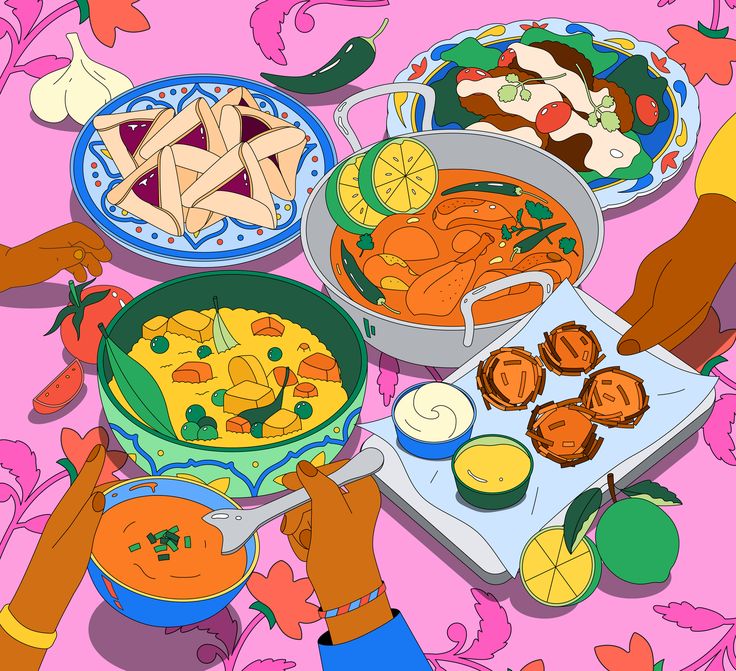
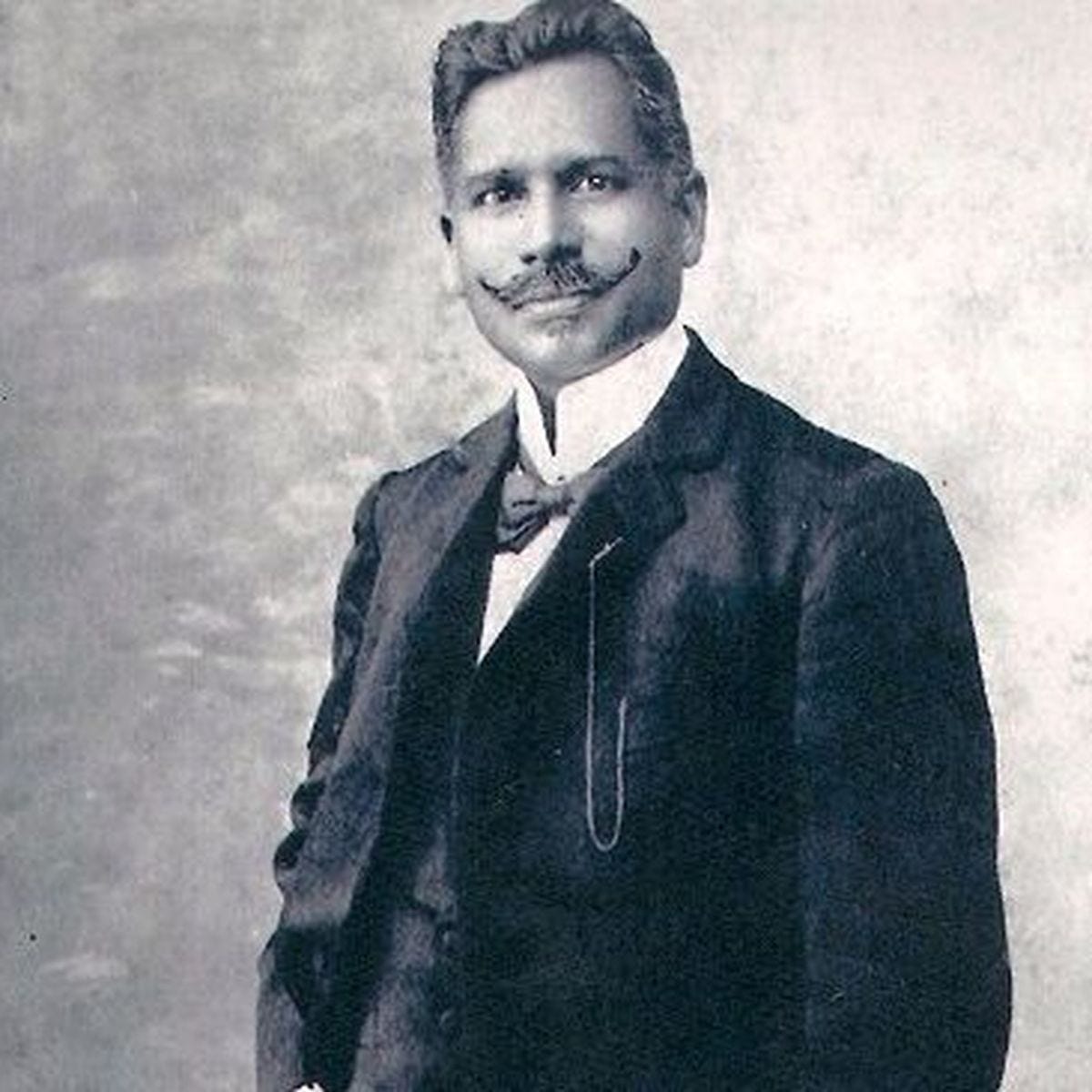
A few days ago I posted a carousel on Instagram, about Henry Sidambarom, the son of a Tamil sugar worker who spent nearly twenty years fighting the French colonial administration so that Indian-descended children born in Guadeloupe could be recognised as French. Within hours, someone in the comments asked whether his name was originally Chidambaram. Almost certainly, yes. A French clerk heard a Tamil name, wrote down whatever his ear gave him lol, and that spelling outlived.
That post had been sitting in my head since a train ride from Beaune to Paris. An older gentleman sat across from me, established within ten minutes that I was Indian, and told me how much he loved the curry in Guadeloupe. He then explained the spices to me, in great detail, for most of the journey, while I nodded like a good student and thought about colonial history. I never got to tell him where his favourite dish came from. This essay is partly for him, and partly for everyone who has eaten a colombo, a cari or a dholl puri on holiday and filed it under “exotique”.
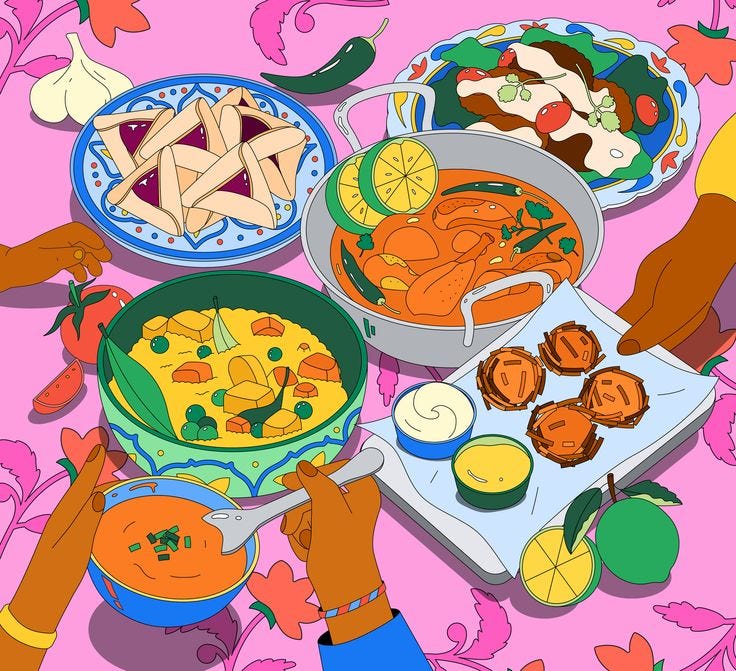
Guadeloupe is one island, but the same story plays out, across Martinique, Réunion and Mauritius. Three of them are still part of France today. Mauritius was taken by the British in 1810 and became independent in 1968, which makes it a useful comparison: a different empire running the same sugar experiment ended up with strikingly similar plates.
Everything here started with sugar
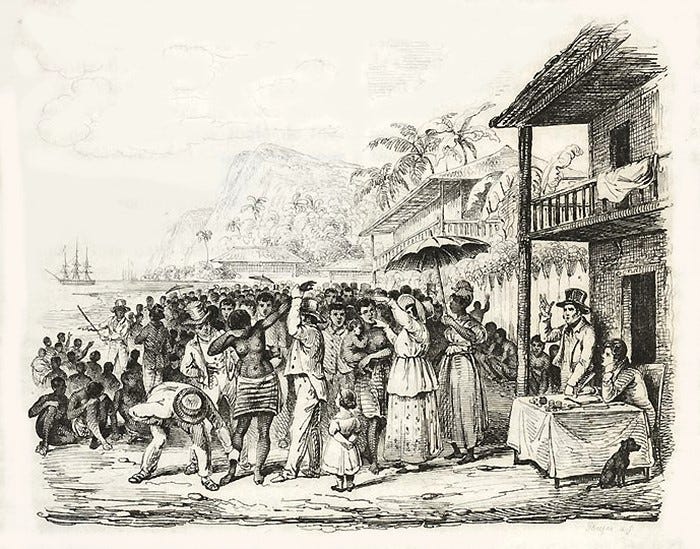
All four islands were turned into sugar machines by enslaved African and Malagasy labour, and when slavery ended, both empires compensated the owners and left the freed people with nothing. I find that detail very intriguing than any amount of moralising, because it tells you whose losses the state considered real.
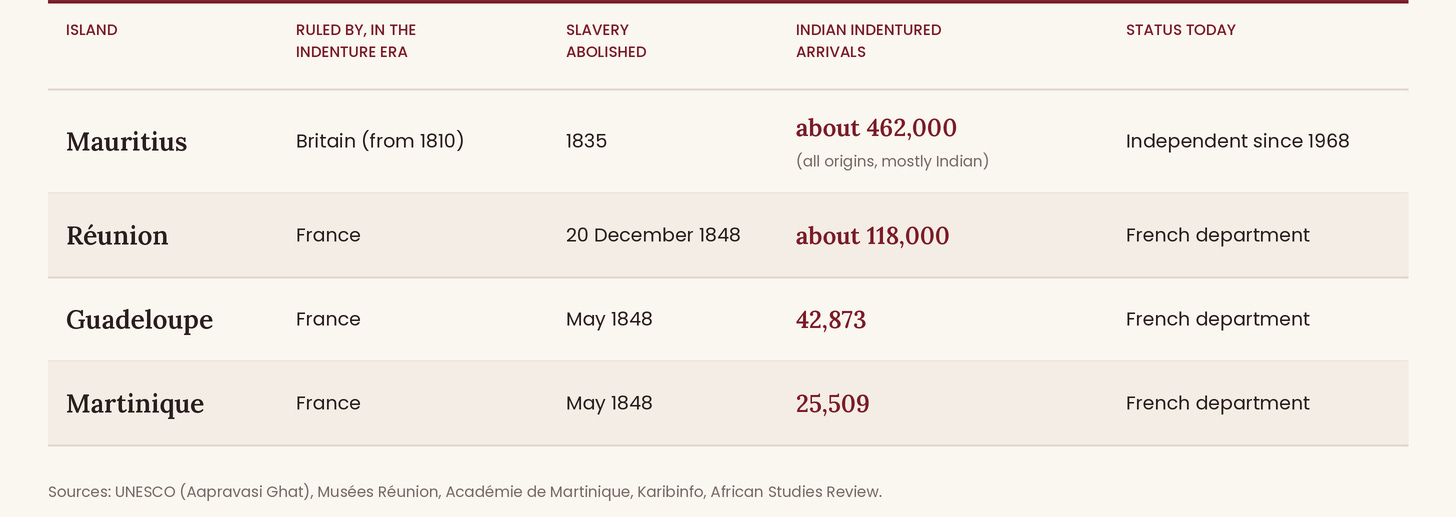
Britain abolished Slavery in Mauritius in 1835, when 61,045 enslaved people were declared free, and then promptly placed under an “apprenticeship” system that kept them working for their former masters until 1839. Several observers at the time described it as slavery under a nicer name. Parliament set aside £20 million to compensate slave owners across the empire, and the planters of Mauritius walked away with a little over £2 million of it.
France followed with its decree of 27 April 1848, and the enslaved people of Martinique did not wait for it to come into practice. They rose up in May 1848 and forced the governor to proclaim abolition before the decree even landed. In Réunion, freedom came on 20 December 1848, a date the island still celebrates as Fèt Kaf. The following year, the French state paid 126 million gold francs to the former owners in its colonies, because the planters were threatening to pack up and leave. CNRS researchers estimate that sum at roughly 1.3% of France’s national income at the time, the equivalent of about €27 billion today. The rate per enslaved person was highest in Réunion, at 671.79 francs, against 447.28 in Guadeloupe and 409.98 in Martinique.
So by 1850, the cane was still standing, the owners had been paid, and the people who used to cut it for free were understandably not keen to keep doing so for almost nothing. The planters needed a new workforce, and they found it in India.
The ships after the chains
Mauritius was the test case, and it worked so well for the planters that the model spread across the world. The British called it the “Great Experiment”: recruit workers in India on five-year contracts, ship them out, and process them through an immigration depot in Port Louis. More than 462,000 people passed through that depot, the overwhelming majority from India, and around two-thirds of them never left. Roughly 70% of Mauritians today descend from them. For most of its life the depot was known as the Coolie Ghat. It only became the Aapravasi Ghat, Hindi for immigration depot, in 1987, and UNESCO listed it as a World Heritage Site in 2006.
France had a problem the British did not: its Indian territory amounted to five small trading posts, Pondichéry (today Puducherry), Karikal (Karaikal), Yanaon (Yanam), Mahé (Mahe) and Chandernagor (Chandannagar, in West Bengal), a quick fact Puducherry, Karaikal, Yanam and Mahe now make up the Indian union territory of Puducherry, while Chandannagar joined West Bengal in the early 1950s. Recruitment started there, then a Franco-British convention in 1861 opened the door to recruiting in British India, including through Calcutta. As a Bengali, I cannot read without wondering whose great-great-grandfather was on it. Réunion received around 118,000 Indian workers, known locally as Malbars. Guadeloupe received 42,873 and Martinique 25,509.
The contracts promised wages, housing, food rations and a passage home. What they delivered depended on the planter. Historians at the Université de La Réunion have documented fines, imprisonment and violence used to stop Réunion’s engagés from leaving the estates, and the British themselves sent a commission of inquiry in 1877 before cutting off recruitment for Réunion in 1882. Several of those historians argue, quite reasonably, that for the engagés, the logic of slavery carried on well past 1848 under a different legal name.
What the workers did control, at least partly, was the pot at the end of the day. Planters were obliged to feed their workers, and everything that made that food taste like home had to be carried, grown, swapped or improvised. That is where the food of these islands begins.
Mauritius: a whole history folded into a flatbread
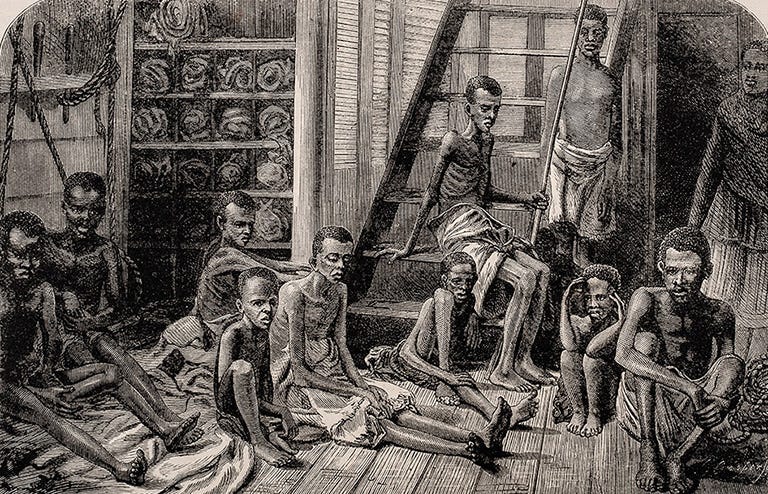
If you want to understand Mauritius in one bite, buy a pair of dholl puri or dal puri. They are always sold in pairs, wrapped in paper, and they are the island’s favourite street food by a comfortable margin. The bread is made with ground yellow split peas seasoned with cumin and turmeric, cooked on a tawa, then folded around cari gros pois (a butter bean curry), rougaille (a spicy tomato sauce), pickles, coriander satini and chilli.
Most of the people who passed through the Aapravasi Ghat were recruited from the Bhojpuri-speaking regions of Bihar and Uttar Pradesh, with large numbers of Tamils, Telugus and Marathis among them. Dholl puri descends from the stuffed flatbreads of that Bihari countryside, rebuilt with whatever was cheap and available on a sugar estate. One of the island’s most famous vendors, the Dewa family in Rose Hill, traces its business to a grandfather who, in the 1960s, shrank the giant dholl puri served at Hindu wedding feasts on banana leaves into a snack and sold it door to door from a pan on the back of his bicycle.
Dholl is a Hindi word, and Cari is the French colonial spelling of a South Indian word. Satini is chutney after a century in Mauritian Kreol, and Rougaille is shared with Réunion and its origins are still argued over. A British colony, run by French-speaking planters, fed by Bihari and Tamil cooks.
The language did not hold on as well as the food. Bhojpuri was spoken at home by 12.1% of Mauritians in 2000 and only 5.1% by the 2022 census. Grandchildren who no longer speak their great-grandparents’ language still queue every morning for the bread those great-grandparents made, which is exactly why I keep calling food an archive.
Réunion: where the curry is the national dish and nobody calls it curry
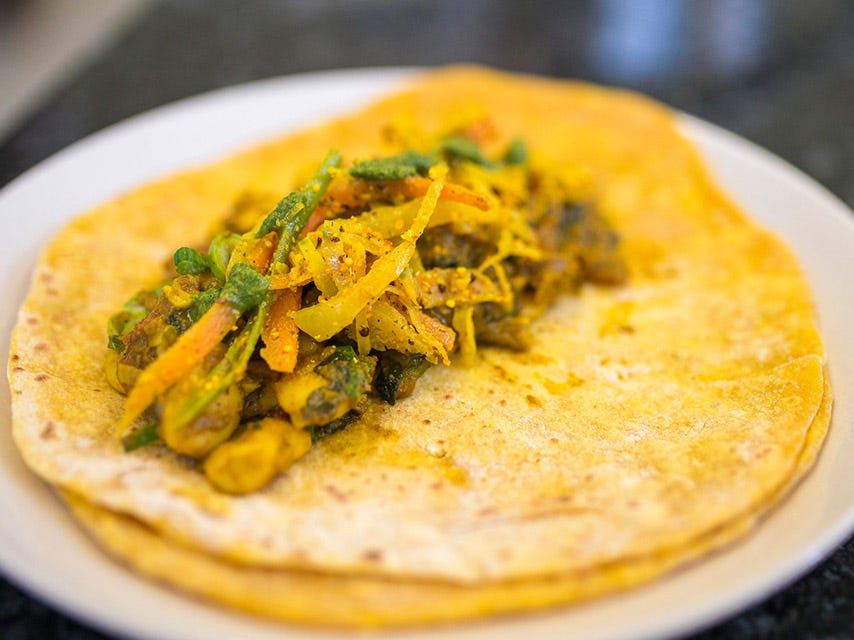
On Réunion, the everyday plate is cari: meat or fish simmered in a sauce of tomato, onion, garlic, ginger and the local spice blend, served with white rice, lentils or beans and a sharp rougail on the side. French dictionaries list cari as a word of Tamil origin, and the dish is just as frank about its roots. It runs on massalé, a powder of cumin, mustard seed, coriander and fenugreek, and on safran péi, which is what Réunionnais call the turmeric grown on the island. Rougail, the fiery tomato, onion, ginger and chilli condiment, is often traced to Tamil too.
The dish closest to the Malbar story is cabri massalé, goat cooked with massalé, garlic, turmeric, ginger and chilli. In Tamil Hindu practice on the island, the goat is often the offering at a temple ceremony, and the meat is cooked and shared afterwards.
Then there is everybody else. Gujarati Muslim merchants, whom Réunion calls Z’arabes, arrived from the mid-nineteenth century and brought the samoussa that now turns up at every apéritif. Cantonese migrants brought the steamed bouchons sold at every snack bar. Bonbons piments, the chilli and cumin fritters made from ground pulses, are an Indian snack with a Creole name. Before any of them, the enslaved Malagasy and East African population had already laid down the base of the island’s Creole cooking.
Martinique and Guadeloupe: colombo, and the poison in the soil
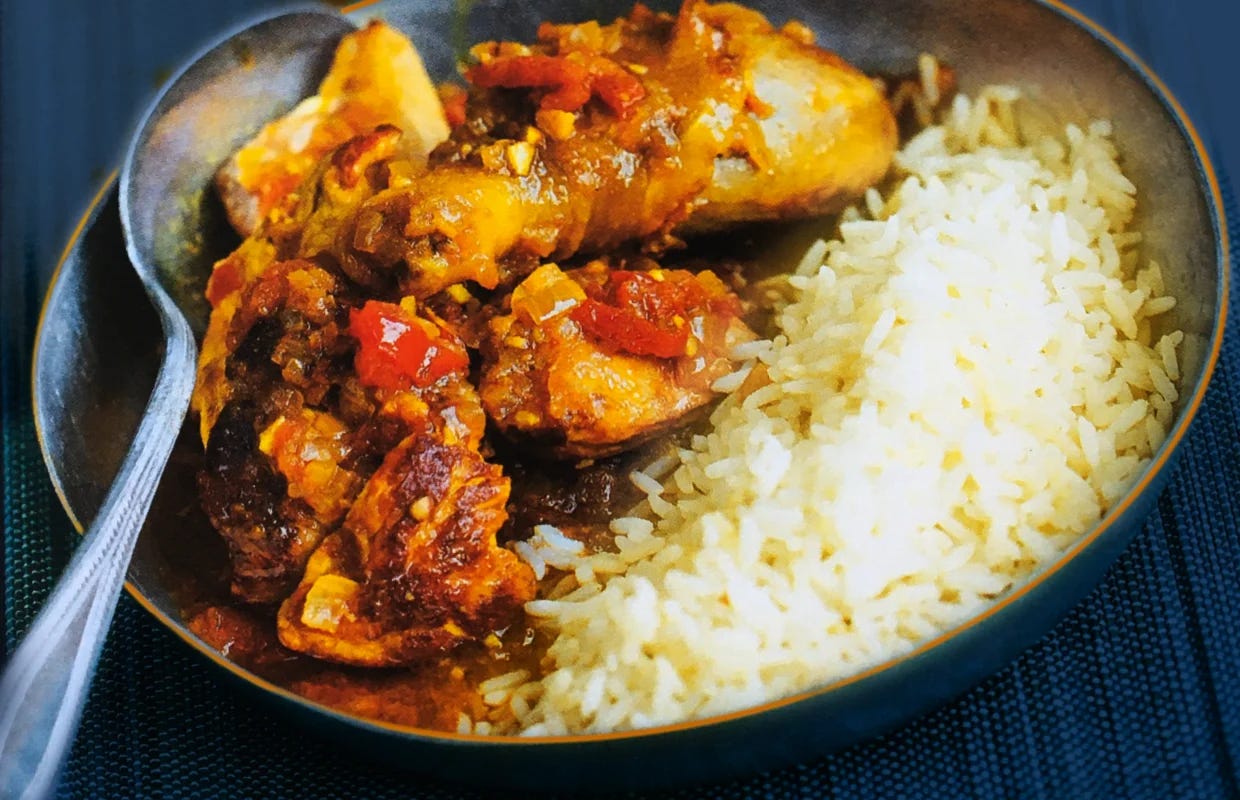
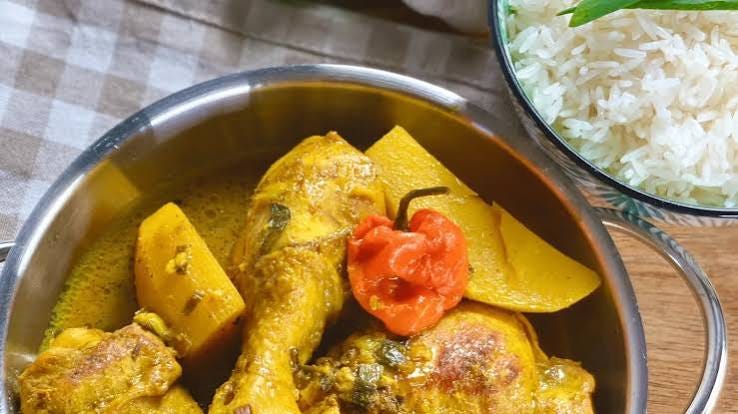
If you read my carousel on Sidambarom, you already know colombo. It is considered the national dish of both Guadeloupe and Martinique, and it grew out of the spice mixes Indian engagés rebuilt on the islands. Raw rice is toasted and ground in with coriander, cumin, turmeric, fenugreek and mustard to thicken the sauce, and local bois d’Inde (which after research I got to know is bay leaf) stepped in for spices nobody could buy. Most sources trace the name to the Tamil kulambu; others point to the port of Colombo, where some ships stopped. Either way, the label was settled by people outside the kitchen, which is a pattern you will recognise if you have followed my curry powder posts.
The story of food on these two islands did not stop with the engagés, and the next chapter is much uglier. Between 1972 and 1993, the French state allowed chlordecone, a pesticide used against the banana weevil, to be sprayed across the banana plantations of Guadeloupe and Martinique. The World Health Organization had flagged it as a possible human carcinogen in 1979. Mainland France banned it in 1990, and ministers kept signing exemptions so the Antilles could go on using it for three more years. The chemical persists in soil and water for centuries, it found its way into local food, and today more than 90% of adults in both islands carry traces of it in their blood, according to Santé publique France. The Antilles also have one of the highest prostate cancer rates in the world, and in 2019 Inserm found a strong presumption of a link with chlordecone exposure.
In January 2023, two Paris investigating judges dismissed the criminal case for lack of evidence, while describing it as a health scandal in the same breath. When the dismissal was looming, one of Guadeloupe’s protests took place in Capesterre-Belle-Eau, Sidambarom’s hometown and banana country. I keep returning to Aimé Césaire, the Martiniquais poet who wrote in his Discourse on Colonialism that colonisation equals “thingification.” A plantation economy that treated people as inputs in 1854 was still spraying them like inputs in 1993. Families who grow their own root vegetables to cook the dishes their grandparents taught them have had to ask whether their own garden is safe.
Who feeds the islands now?
Islands that were designed to export sugar and bananas now import a large share of what ends up in their supermarket trolleys, and they pay a premium for the privilege. In 2022, Insee found food was 42% more expensive in Guadeloupe than in mainland France, 40% more in Martinique and 37% more in Réunion. These are French departments, using the euro, governed by the same Republic that sets the minimum wage, and a basket of groceries costs almost half as much again.
The explanations depend on who you ask I guess. The Cour des comptes points at the octroi de mer, an import tax that brought in €1.64 billion across the overseas departments in 2022 and funds about a third of local councils’ budgets. In Martinique, Libération has reported that the Békés, the descendants of the white planter families, make up around 1% of the population, own about half the land and control roughly 90% of the agri-food industry. If you have read this far, you will notice that the names at the top of the food chain have not changed very much since 1849.
People have not taken it quietly by the way. In 2009, Guadeloupe and then Martinique shut down for weeks in general strikes against what they called pwofitasyon, Creole for profiteering. Réunion had its own cost of living protests in late 2018. In September 2024, protesters in Martinique blockaded the port of Fort-de-France demanding that grocery prices be aligned with the mainland, and the unrest led to a protocol signed in October 2024 between the state, distributors and local officials. The Autorité de la concurrence reported in February 2026 that the measures helped and remained insufficient. A colombo in Martinique still costs more to cook than the same colombo in a mainland France, which is one of those sentences that should not be true in a country that calls these islands France after making them suffer so much.
Decolonising the plate, and what I would pair with it
Walk into almost any French supermarket and you will find colombo powder, massalé and cari mixes on the shelf marked produits exotiques, a few metres from the regional French cheeses that get their own counter, their own appellations and their own little maps. Pierre Bourdieu wrote that taste classifies, and it classifies the classifier. The supermarket aisle is a classification system, and it quietly tells you which food belongs to the nation and which food belongs to the holiday brochure. Krishnendu Ray my favourite professor to source from, calls this the hierarchy of taste: the cuisines of people who arrived as labour are expected to stay cheap, cheerful and slightly mysterious, while the cuisines of people who owned the land get treated as heritage.
Also, I cannot write anything without a glass in hand, here is what I would actually pair. With a pair of dholl puri and cari gros pois, a chilled Gamay from Beaujolais has the red fruit and low tannin to handle the chilli without sulking. A Réunion cari poulet heavy on turmeric and thyme sits beautifully with a Viognier, and a colombo with lime and toasted rice loves a white Mâconnais like Viré-Clessé. For cabri massalé, I would open a young Bourgogne (Burgundy) Pinot Noir from the Hautes-Côtes, bright enough to cut through goat and spice. On the islands themselves, people will hand you a ti-punch made with rhum agricole, and Martinique’s is the only rum in the world with its own AOC, which is a very French way to honour a drink built on sugar cane.
So, to the gentleman on the train from Beaune: you missed the ships, the contracts, the court case and the poison in the soil, and those are the reasons the dish exists at all. Bon appétit, until the next time!
Sources
Abolition and compensation
CNRS Repairs project, compensation database (via Portail Esclavage Réunion)
Guichet du Savoir, per-person indemnity rates by colony
Société d’Histoire de la Guadeloupe, L’indemnité coloniale de 1849 (2009)
African Studies Review, The Apprenticeship System in Mauritius
Leela Gujadhur Sarup, Colonial Emigration: Annual Reports from the Port of Calcutta, Vol. III
Indenture
UNESCO World Heritage nomination, Aapravasi Ghat
Mauritius Now, Aapravasi Ghat
Musées Réunion, Les engagés du sucre exhibition press kit (2025)
Académie de Martinique, L’engagisme en Martinique et en Guadeloupe
Université de La Réunion (HAL), Confusion entre esclavagisme et engagisme à La Réunion
Karibinfo, arrivals and departure ports for Guadeloupe (2025)
Mauritius
Air Mauritius, summary of The Guardian on dholl puri
Defimedia, Dewa dholl puri in The Guardian
Wikipedia, Mauritians of Indian origin (Bhojpuri census figures)
Réunion
Wiktionnaire, cari
Wikipedia, Cuisine of Réunion
Lonely Planet France, Réunion culture and traditions
Ryo, culinary specialties of Saint-Denis
Arte, Voyage en cuisine: cabri massalé
Martinique and Guadeloupe
Sailoe, Caribbean food in Guadeloupe
Colombo Histories, Tasting Colombo (Twice) (2026)
Reporterre, deputies recognise state responsibility for chlordecone
Le Quotidien du Médecin, the January 2023 dismissal
Natura Sciences, chlordecone protests in Martinique and Capesterre
Aimé Césaire, Discourse on Colonialism (1950)
Food prices and protests
Assemblée nationale, bill on the cost of living overseas, citing Insee 2022
Autorité de la concurrence, Avis 26-A-01 (February 2026)
Moneyvox, octroi de mer and the Cour des comptes
Maire-info, the 2024 Martinique movement and 2009 strike
Equal Times, chlordecone, health and racism (citing Libération on Béké land ownership)
Theory and literature
Pierre Bourdieu, Distinction: A Social Critique of the Judgement of Taste (1979)
Krishnendu Ray, The Ethnic Restaurateur (Bloomsbury, 2016)
Seagull Books, Khal Torabully, Cargo Hold of Stars: Coolitude
Social History Portal, review of Carter and Torabully, Coolitude


Leave a comment