

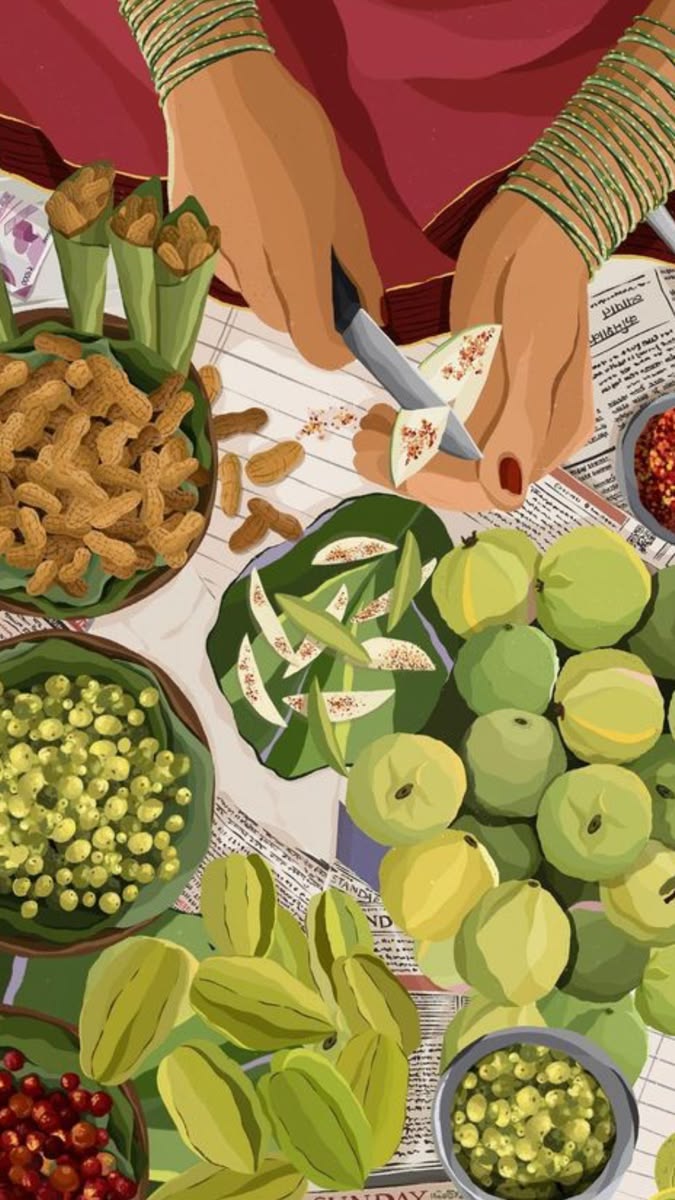
I served a dinner course few years ago that was designed to be picked up. A small thing, the guest lifted it with her fingers, ate it, and reached for the towel that had been placed there in anticipation of exactly that. The room cost several hundred euros a head and the whole sequence had been engineered by a chef who understood that some food is better delivered by hand and had built the service around that fact.
I have thought about that plate a lot since, because I have also had a stranger type ew under a video of me eating rice with my fingers. Wildly different verdict when I am having the food with my hands.
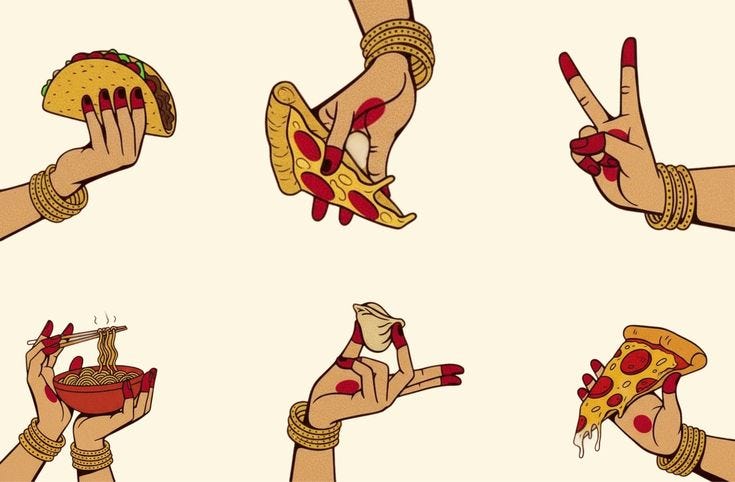
Once you start noticing this you cannot stop. European fine dining is one of the most hand-intensive eating cultures on earth. Canapés, Oysters, lifted to the mouth. Bread, torn. Globe artichoke, dismantled leaf by leaf, which Debrett’s confirms is the only sensible method. Asparagus without sauce, picked up and caviar, increasingly, served onto the back of the guest’s hand, a practice Charles Spence describes in his 2022 paper on tasting with the hands as having become something of an Instagram sensation.
Now look at the other end. Fried chicken, Burgers, hands, at least in the country that invented them. Corn on the cob, ribs, tacos, chips. An entire fast food industry built on the assumption that people will use their fingers.
So hands are permitted at the top of the class ladder and at the bottom. The prohibition lives in the middle, in the anxious, aspirational, respectable middle, which is exactly where you would expect to find a rule that exists to prove something.
Dirt is matter out of place
Mary Douglas worked this out in 1966 and it remains the most useful sentence anyone has written about the subject. Dirt, she argued, is matter out of place. Soil in a garden is not dirt. The same soil on a kitchen counter is. Nothing about the substance changed but the category it violated.
Now apply to this on hans of a person of colour, the person who wrote ew was not conducting a risk assessment. They were not weighing bacterial load on a washed palm against bacterial load on restaurant cutlery, which incidentally travels from a dishwasher through a drawer through a server’s grip to your mouth, and which nobody has ever thought about for even a second. They were registering a category error. Food is supposed to arrive by tool, but here it arrived by hand.
Something is out of place and because disgust arrives in the body before it arrives in the argument, it feels like knowledge. That is the trap most of all fall for. It feels like you have observed something unhygienic, when what you have actually done is notice a rule you were raised inside.
Which explains why the reaction is so uneven. The caviar bump does not violate the category, because the category is really about who is in control of the room. A three star chef choosing to place fish eggs on your skin is exercising authority. A woman from India eating her own dinner in her own kitchen is not, in that reading, exercising anything. Same physical act, opposite social meaning, and the meaning is what people are actually reacting to.
What the hand is actually doing
The part that frustrates me most is the assumption that hand-eating is what happens in the absence of a tool. As though we simply never got round to inventing the fork and have been improvising for four thousand years.
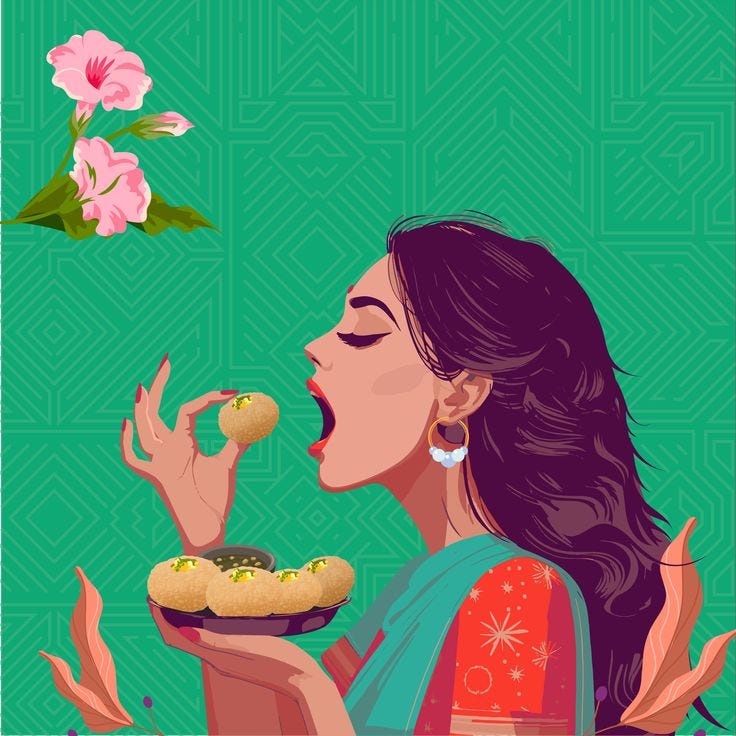
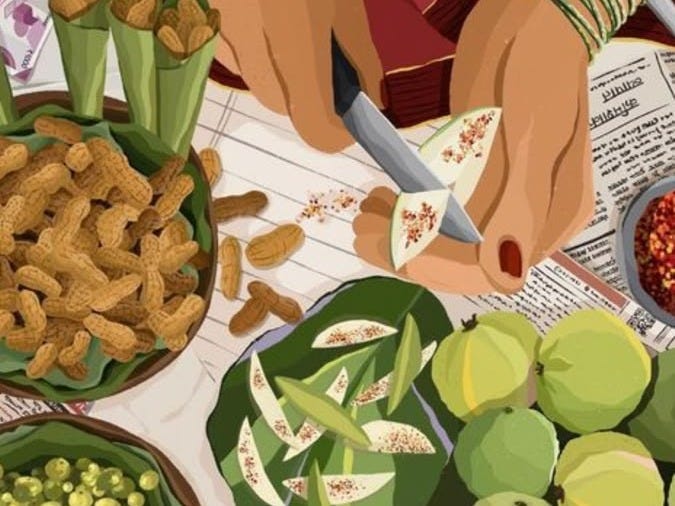
Sit at a table in India and watch someone eat properly. There is a technique, and it is not decorative.
The hand builds each mouthful individually. Rice, a little of the dal, a fragment of the fried thing, a smear of pickle. The ratio is decided in the moment and it is different for every bite, adjusted according to how salty the last one was, how much heat has accumulated, whether the pickle is dominating. The mouthful is composed rather than collected.
A fork cannot do this because it gives you a fixed unit of whatever it happens to spear. A spoon gives you an undifferentiated scoop. The hand gives you editorial control over every single bite, and the whole architecture of a South Asian meal, several dishes at once rather than a sequence of courses, is designed around the assumption that the eater is doing that work.
Waitt Waitt there is more!! The hand reads temperature before the mouth does, which matters enormously when the food is hot and the eater is small. It reads texture, so you know whether the rice has been cooked correctly before you commit to it. It handles bones and shells with a precision that no cutlery has ever managed, which is why fish is a hand food across most of coastal Asia and why anyone who has picked a hilsa apart with a fork has produced a tragedy.
I think about this in wine terms, because that is where my head lives. What the hand is doing is blending. It is assembling a component wine every time, adjusting proportions to correct for the last pour. What the fork does is serving. It delivers what is in front of it, in the order it finds it.
We would never call a blender less skilled than a person operating a tap. Yet the tool that performs the more complex operation is the one that gets called primitive, too hypocritical no?
The wine industry does the exact same thing in the opposite direction
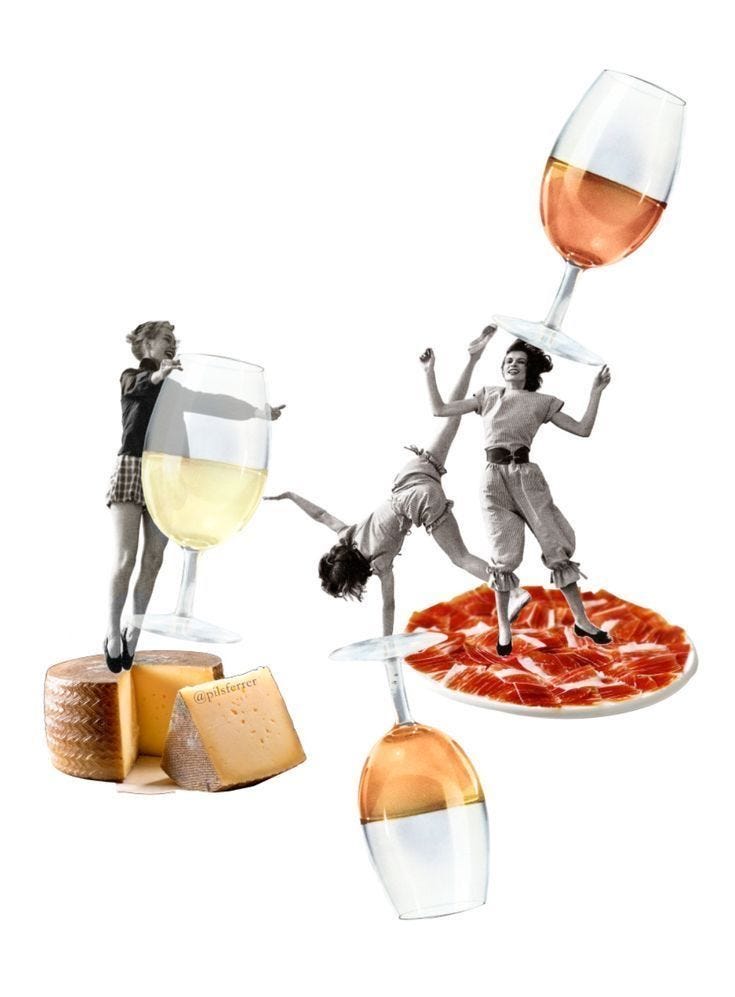
The wine world sells vessel-correctness with enormous confidence and remarkably thin evidence. Riedel built a global business on the claim that varietal-specific glass shapes direct wine to different zones of the tongue, and for years the demonstration leaned on the tongue map, the idea that sweet, salt, sour and bitter live in different districts of your mouth.
The tongue map is wrong as it was discredited decades ago by Linda Bartoshuk at Yale, who has done foundational work on taste perception, has been blunt that those four tastes register anywhere on the tongue there are taste buds.
Daniel Zwerdling laid this out in Gourmet in 2004 in a piece called Shattered Myths, reviewing studies from research centres in Europe and the United States, including work at the University of Bordeaux in 1998. One researcher he interviewed concluded flatly that glass shape does not affect the perceptions of the average consumer. Her subjects could not reliably distinguish the same Merlot served in a red wine glass, a Champagne flute or a Martini glass. A University of Tennessee study that got trumpeted internationally as vindication turned out, on inspection, to be an undergraduate project that had concluded roughly the opposite of what the headlines said.
I am not telling you glassware is meaningless. Context shapes perception, expectation shapes perception, and a heavy stem in a beautiful room absolutely changes what you experience, which is a real effect and a legitimate one. Harrar and Spence at Oxford showed exactly this with cutlery in Flavour in 2013, where the same cheese was rated saltiest off a knife rather than a fork or spoon, and where diners given heavier cutlery in a restaurant were willing to pay more for the same food.
When Europeans insist that a vessel changes the experience of what you consume, that is expertise. It gets an industry, a price point, a demonstration tour, a certification.
When Asians have been saying for millennia that the vessel changes the experience, and the vessel is a hand, that is superstition. That is something you grew out of.
Both claims are about how delivery shapes perception. One of them, awkwardly, has better evidence than the other.
The part where we do it to ourselves
The hand is policed inside India too, and often more sharply than it is policed abroad.
There is a whole stratum of Anglophone, convent-educated, aspirational Indian society that treats hand-eating as something you do at home and never in front of guests. The cutlery comes out when company arrives. Children get told to use a spoon in front of visitors. Parents worry, not without reason, that a child who eats with her hands at a hostel or an office lunch or an interview will be read a certain way, and so the correction gets passed down as protection rather than as shame.
That is the colonial hierarchy operating with no colonisers left in the building. It does not need enforcement any more. It has been internalised so thoroughly that it now transmits through affection, which is the most durable delivery mechanism there is.
I am not interested in shaming anyone for that. I have relatives who switched to cutlery in front of guests my whole childhood and they were navigating a real social risk, not an imaginary one, but I think it is worth naming, because it disproves the lazy version of my own argument. This is not white people versus everyone else. This is a status system that got installed a long time ago and that plenty of us maintain without noticing.
What gets lost in translation
There is a knock-on effect I only really understood after working in professional kitchens in Europe.
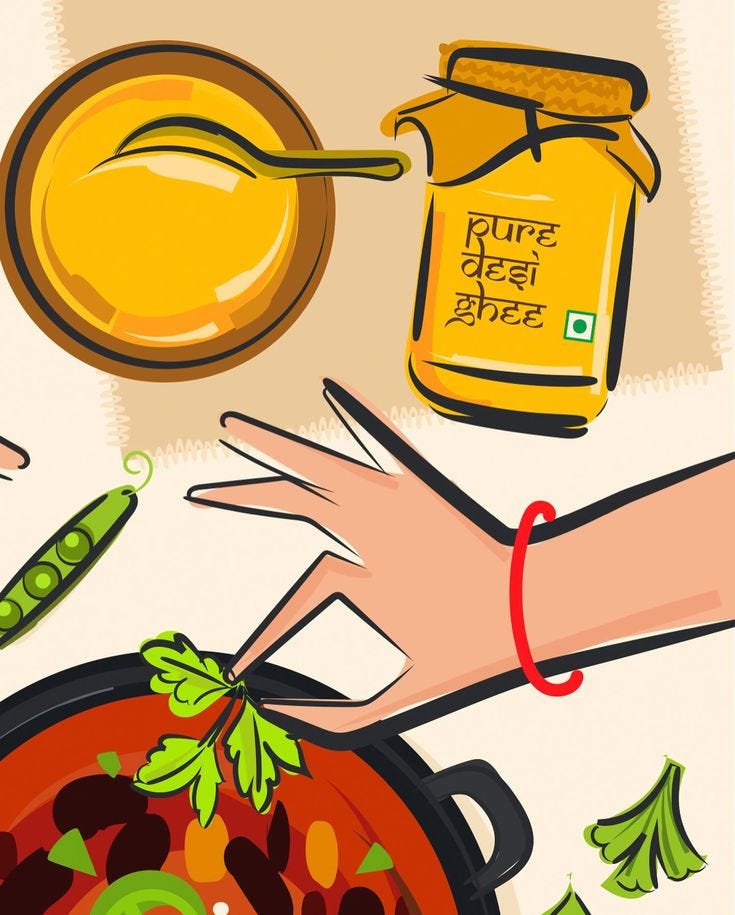
When a cuisine relocates and has to become legible to a fork, it changes. Consistencies get adjusted so things stay on the tines. Textures that were designed to be picked up get replated as things that can be cut. Dishes that only make sense in the composed-mouthful architecture, where you build the ratio yourself, get pre-composed by the kitchen, which is a different dish wearing the same name.
Some of that is genuine adaptation and adaptation is what living cuisines do. I am not romantic about authenticity, and I have written before about how badly that word behaves.
However, some of it is loss, and it is worth being able to tell the difference. A dish reformatted to survive in a fork-based dining room has had a decision made about it, usually by someone reading a market rather than a recipe. When the diaspora restaurant puts cutlery on every table by default and only produces a finger bowl if you ask, that is a room making a guess about who it needs to reassure.
What does this Indian actually want?
Not an apology, and not for anyone to start eating rice with their fingers to prove a point. If you want to cut your pizza with a knife, cut it. New York shamed its own mayor for that in 2014 and Italy and France quietly does it every day with their bread, which should tell you how seriously to take any of these rules.
What I want is narrower and I think more achievable.
I want the hand understood as a technique with rules, a long training period and a real skill ceiling, rather than as the absence of a tool. I want people to notice the moment their disgust arrives and to ask it one question, which is whether it would have shown up if the same hand had belonged to a chef in a room with a tasting menu. My hands are not a charming ethnic quirk to be defended. They are a more sophisticated piece of equipment than the fork, doing a harder job, older than the alternative by several thousand years.
I know which glass opens the service. I also know how to build a mouthful, only one of those took me twenty years to learn.
Sources
Mary Douglas, Purity and Danger: An Analysis of Concepts of Pollution and Taboo, 1966 Charles Spence, “Interacting with food: Tasting with the hands,” International Journal of Gastronomy and Food Science, 2022 Vanessa Harrar and Charles Spence, “The taste of cutlery,” Flavour, 2013, 2(21). DOI 10.1186/2044-7248-2-21 Daniel Zwerdling, “Shattered Myths,” Gourmet, August 2004, including the University of Bordeaux 1998 work, the University of Tennessee misreporting, and Linda Bartoshuk of Yale on the tongue map Debrett’s, A Practical Guide to Table Manners; Emily Post Institute, guide to food and drink Forkgate coverage: TIME, NPR, CBS New York, Slate, January 2014 Ayurveda market valuations from Towards Healthcare and Market Research Future, 2026, noting that estimates vary considerably between firms WHO figure on traditional medicine use, cited via Grand View Research Korean food export figures reported in 2026 K-food market analyses Atlas Obscura and PBS SoCal on kamayan, its decline under colonial rule and its current pricing


Leave a Reply