


Ask almost anyone who has read a wine column what to drink with “Asian food,” and you will get the same two words, in the same order, with the confidence of a catechism. Riesling. Gewürztraminer. A Moscato is occasionally permitted to join if the person is feeling reckless. It does not matter what is actually on the plate. Cantonese steamed fish, a Bengali shorshe ilish thick with mustard oil, a numbing Sichuan mapo tofu, a plate of Japanese sashimi that has never met a chilli in its life, a saffron-scented Persian rice, the answer arrives before the question has finished forming. Before we get anywhere near the wine, though, I want to sit with the first half of that sentence, because it is doing far more damage than the second. What, exactly, does anyone mean by “Asian food”?
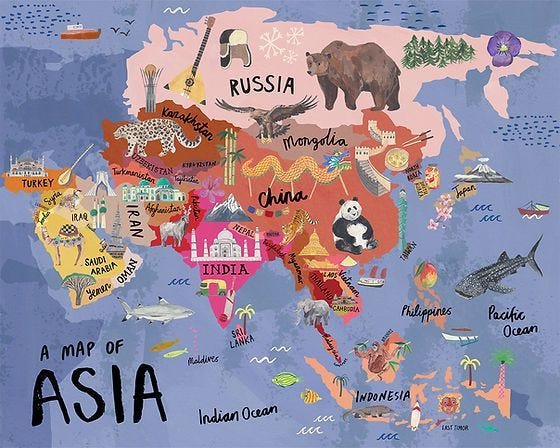
A Continent Is Not a Cuisine
Start with a number, because the number alone should end the conversation. According to the United Nations, Asia contains 50 countries, including Russia and Taiwan. The continent is usually divided into five subregions: East Asia, Southeast Asia, South Asia, Central Asia, and Western Asia, which is to say the Middle East. That is roughly four and a half billion people, well over half of everyone alive on the planet, carrying several thousand years of separate, unrelated, fiercely distinct culinary traditions, all folded into a single heading on a wine list as though they were one flavour.
Japanese washoku, recognised by UNESCO as intangible cultural heritage, built on restraint, seasonality, and precision. Korean cooking, bold and deeply fermented and layered. Thai food balancing sour, sweet, salt, and heat inside a single mouthful. Vietnamese cooking built on herbs and broth and lightness. Then you reach South Asia, where India alone is not one cuisine but dozens. A Goan fish curry shares almost nothing with a Kashmiri rogan josh, which shares almost nothing with a Bengali fish steamed in mustard, which shares almost nothing with a Tamil breakfast eaten off a banana leaf. Add Sri Lanka, Pakistan, Bangladesh, Nepal.
Then keep going, because the flattening only gets worse the further west you travel, into the parts of Asia the “Asian food” label forgets entirely. Central Asia sets its own deep table, the plov and hand-pulled lagman noodles and slow-cooked lamb of Uzbekistan and Kazakhstan, a cuisine built along the trade routes that fed the entire Silk Road. Western Asia, which the West prefers to call the Middle East precisely so it does not have to think of it as Asia at all, holds Persian cooking with its saffron rice and its layered stews, the mezze traditions of the Levant, the kitchens of Turkey and the Caucasus and here is the detail that should embarrass wine people more than any of it. The oldest evidence of winemaking anywhere on earth traces to Georgia, Armenia, and Iran, all of them in western Asia. The very drink doing the condescending was born in the continent it condescends to. “Asian food” is not a cuisine. It is a shrug that 48 countries got filed under, because the person doing the filing could not be bothered to look any closer.
BTW, nobody who writes about wine would ever dream of doing this to Europe.
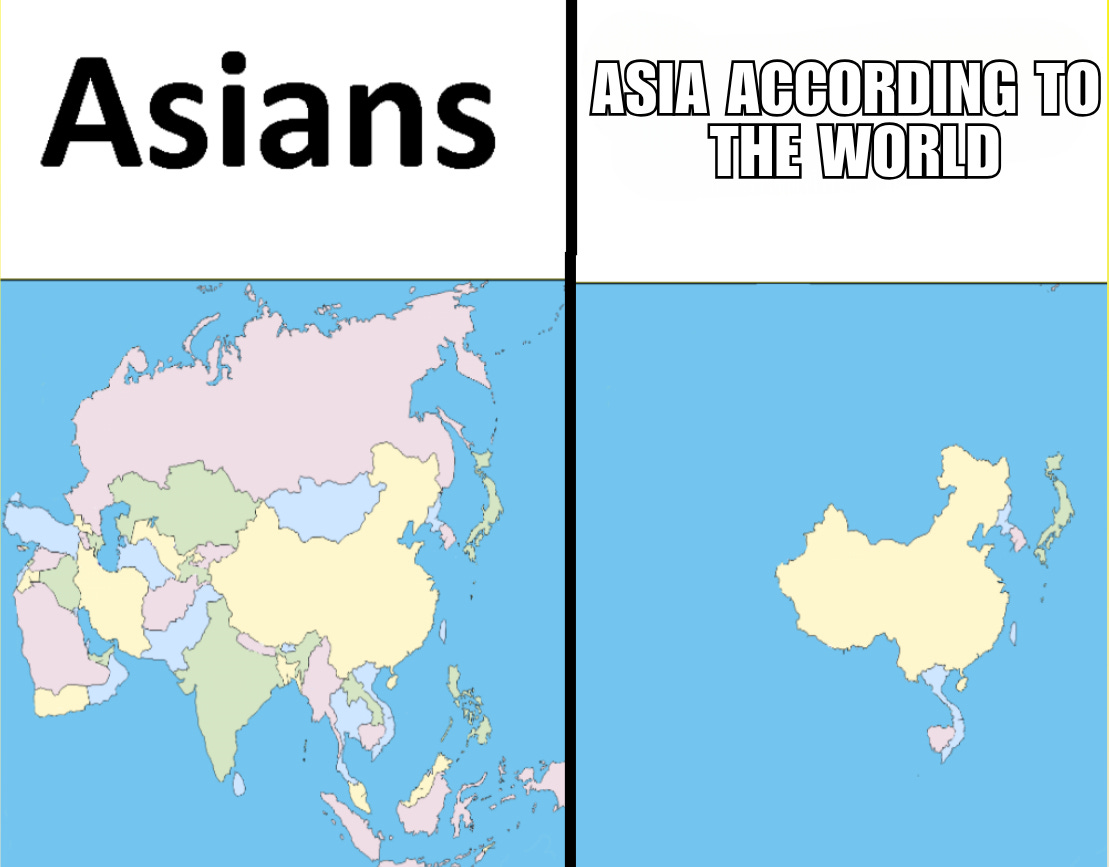
The Tell: Western Media Only Slows Down for European Food
Watch how the same publications, the same writers, and the same guides treat European food, and the double standard stops being subtle. French regional cooking is handled with something close to reverence. Bourgogne (Burgundy) alone gets broken down by village, by climat, by producer, by vintage, and that level of granularity is treated as the baseline of professional competence, not as a special effort anyone should be thanked for. Italy is mapped region by region, Piedmont against Sicily against Emilia-Romagna, each with its own grapes and dishes and internal logic. Spain, Portugal, Germany, all of it is afforded the same patient attention to difference. Nobody has ever written the sentence “European food, pair with red.” The idea is absurd on its face, because everyone already understands, without being told, that a Provençal daube and a plate of Bavarian sausages are not the same event.

Then the writer reaches everything east of Europe, and the granularity simply evaporates. 50 countries collapse into one word and two grapes. The care, the curiosity, the patience to notice difference, all of it turns out to have been reserved for the food the Western palate had already decided was worth the trouble. This is the actual laziness, and it is worth naming plainly, because it is not a general laziness. Wine media is diligent, obsessive even, right up until the moment the food stops being its own beloved European canon, and then it cannot be bothered to look. The effort was always available. It was simply never extended eastern side.
Now, the Wine
Let me be fair to the wine itself, because the grapes did nothing wrong, and the pairing logic underneath the cliché is not invented. This deserves to be pulled out and examined on its own, because people collapse two separate things into one constantly. There is genuine sensory reasoning behind reaching for an off-dry aromatic white. Residual sugar softens the burn of capsaicin, the compound that makes chilli register as heat, more effectively than almost anything else you can pour into a glass. High acidity slices through fat, salt, and fried richness the way a squeeze of lime does. The loud aromatics of Gewürztraminer, all lychee and rose and crystallised ginger, can stand beside fragrant spice instead of being flattened by it. A well-made off-dry Riesling against a genuinely fiery Thai curry is a small joy, and I will pour it for you happily.
Stop Stop….!! The problem is that the chemistry was worked out once, for one narrow band of dishes, and then stretched to cover a continent it was never measured against. Off-dry Riesling makes sense against heat. It makes far less sense against a delicate Cantonese steamed fish, or a clean bowl of Japanese dashi, or a dal from South Asian countries, or a spread of Levantine mezze, none of which are fighting any heat at all. The advice is not wrong because Riesling is a bad wine, but its wrong as it answers a question about chilli and then pretends it has answered a question about 50 countries.

General Tso Was Never Sichuanese
Here is the clearest evidence that this advice is a reflex rather than a thought: it does not even know the food it claims to be pairing. The wine writer Pinny Tam, who has spent years blogging specifically about Chinese food and wine, describes strangers offering her the identical recommendation the moment they learn her subject, Riesling and Gewürztraminer, recited like a password. One enthusiast pressed Moscato on her for “spicy Sichuan General Tso’s chicken.” General Tso’s chicken is not Sichuanese. It is barely Chinese. It was invented to flatter the American palate and named after a nineteenth-century general most of the people recommending it could not place on a map. The pairing advice was so automatic that it sailed clean past the fact that the dish itself is a fiction. That is what laziness sounds like when you play the tape back at half speed.
How Wine Media Manufactures a Cliché
So where does the sentence come from, and why will it not die? Tam points straight at the machinery, and having filed enough copy of my own, I recognise every bit of it. A wine writer, usually working from inside a fairly homogenous pool, gets handed an assignment on pairing wine with “Asian” food, due tomorrow morning. They reach for what they already know and what the last twenty articles said, and out comes butter chicken with off-dry Riesling, again. Readers absorb the same idea from a small circle of writers quietly repeating one another. Then the search engines index the consensus, the SEO machine rewards agreement over originality, and the next writer researching the topic hits a wall of results all saying the same thing, which they dutifully paraphrase into the next piece. The cliché is not a conclusion anyone actually reached through tasting. It is a loop that has been running for so long that everyone involved has mistaken it for knowledge.

The Hierarchy of Taste Underneath It All
None of this is really about wine, though, and this is the part the trade would rather not examine. The gap between how Europe and Asia get treated is not an accident of page space or an innocent hole in someone’s knowledge.
It is a hierarchy, and the sociologist Krishnendu Ray gave that a name. In his book The Ethnic Restaurateur he calls it the hierarchy of taste, and his argument is blunt. We rank cuisines according to the perceived prestige of the people who cook them, not according to the food on the plate. Cuisines climb the ladder as their home countries gain economic and cultural power, and slide back down when they lose it.
Japanese food was “cheap” until Japan became an economic force, and then it quietly ascended into fine dining. Italian food was poor immigrant food until it was not. Chinese, Indian, and much of the rest of Asia stayed filed under “cheap eats,” which is why a diner will happily pay a premium for steak frites and then balk at the same quality of meat served as carne asada. The word “ethnic,” as Ray points out, lumps every non-European cuisine into a single undifferentiated category of other. “Asian food” as a wine-pairing heading is that exact move. It flattens dozens of traditions into one problem to be solved, and then solves it once, cheaply, permanently.
The Cuisines Were Never Waiting to Be Rescued
There is one last thing the two-grape reflex quietly erases, and it might be the funniest, because it exposes how provincial the supposedly sophisticated position actually is. Every cuisine being flattened here arrived with its own drinking culture, fully formed.
Japan has sake and a tea-pairing tradition refined over centuries. China carries an entire grammar of tea alongside its food, plus baijiu and a serious beer culture. India reaches for lassi, for chai, and increasingly for very good craft beer against its heat. Central Asia has its teas and its fermented dairy drinks. And western Asia answers the wine question with wine, the qvevri wines Georgia has been making in clay for something like eight thousand years, long before Bourgogne (Burgundy) had a name.
The wine world likes to cast itself as the discerning outsider arriving to rescue these cuisines with the correct European bottle, when the cuisines were never standing around waiting to be rescued. They had their answers long before the question was ever posed in a wine glass. Insisting that the true sophistication lies in locating the right Alsace Riesling is not open-mindedness, but Eurocentrism.
Pair the Dish, Not the Continent
So here is where I land, as someone who pours these wines for a living and grew up eating the food they get so casually assigned to. The off-dry aromatic whites are wonderful, and a few of them are genuinely brilliant against specific dishes, and I will keep reaching for them. Pour them because the dish in front of you asks for them, not because a continent triggered a reflex. Set a structured red against a slow, deep mutton curry and watch the richness and the spice hold the wine up rather than collapse under it. Try a saline Chablis with Cantonese ginger and scallion lobster. Put a cru Beaujolais next to a soy-braised chicken and see what happens.
The laziness was never a limitation of the wines. It was a limitation of who got to write the script, how little they were ever asked to think while writing it, and how quickly they were allowed to stop the moment the food stopped being European. That is a choice, which is the good news, because a choice can be unmade.
Sources
United Nations country classifications for Asia, as summarised by Britannica and Worldometer, for the count of 48 countries (49 with Russia, 50 with Taiwan) and the five subregions of the continent.
UNESCO Representative List of the Intangible Cultural Heritage of Humanity, for the inscription of Japanese washoku.
Archaeological evidence for the earliest known winemaking in Georgia, Armenia, and Iran, drawing on the work of Patrick McGovern and the associated excavations, including the qvevri residue in Georgia and the Areni-1 cave winery in Armenia.
Pinny Tam, “Anti-Asian Hate and Why I’ll Never Pair Chinese Food With Riesling,” VinePair, 2021, on the reflexive Riesling-and-Gewürztraminer recommendation, the homogenous and deadline-driven writer pool that reproduces it, and the General Tso’s chicken example as an American invention.
Krishnendu Ray, The Ethnic Restaurateur (Bloomsbury, 2016), for the hierarchy of taste, the ranking of cuisines by the perceived prestige of their people, the ascent of Japanese and Italian food, the “ethnic” flattening, and the steak frites versus carne asada pricing gap.
Established sensory pairing science on off-dry wine and capsaicin, acidity against fat and salt, and aromatic whites alongside fragrant spice (WSET and general pairing literature).


Leave a comment