


There is a romantic idea, still surprisingly common, that great wine is simply a matter of a good site and a patient grower waiting for the seasons to do their work. If you spend any time in a vineyard now and that illusion falls apart quickly. Across the world, winegrowers are fighting an increasingly physical war against the weather, and the tools they reach for are stranger and more inventive than most wine drinkers ever imagine. Some staple tiny paper hats over individual bunches. Some coat their vines in white clay. Some fire chemicals into the sky. What follows is a tour of how very different corners of the wine world are protecting their grapes from heat, rain and hail, and what it tells us about where wine is heading.
Japan: a waxed-paper hat for every bunch
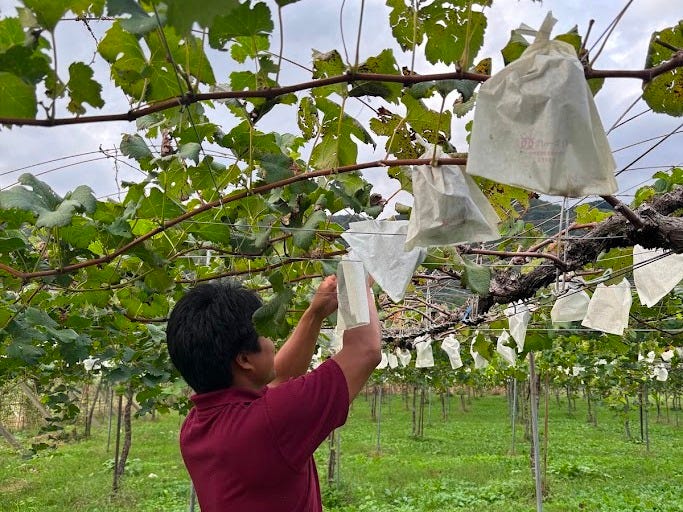
Japan is one of the most difficult places on earth to grow wine grapes, because its summers bring heat, oppressive humidity and rain at exactly the moment the fruit is most vulnerable to rot. Rather than surrender the crop, growers have developed some of the most meticulous viticulture anywhere. The signature technique for the pink-skinned Koshu grape is disarmingly simple. Two sheets of waxed paper are stapled together and fixed over each cluster, forming a little hat that keeps the rain off the fruit and slows the spread of fungal disease. It is beautiful and labour-intensive in equal measure, adding a meaningful cost to every hectare, and it is applied bunch by bunch across entire vineyards.
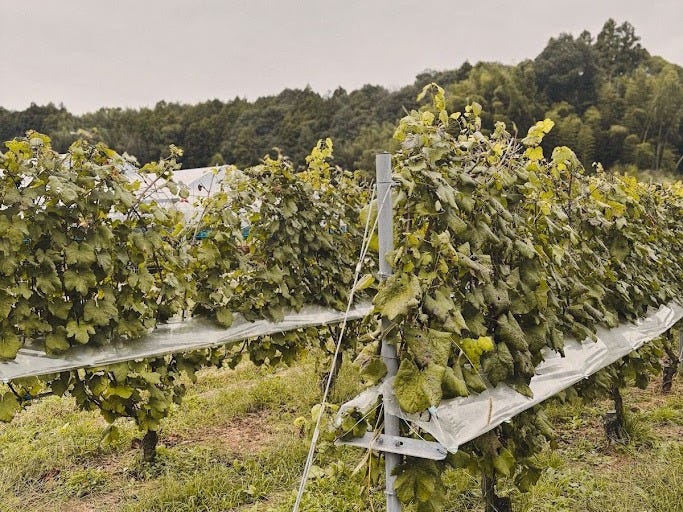
Many Japanese vineyards roof their whole canopy in plastic sheeting, a practice known as rain-shelter cultivation, while others cover only the fruiting zone with a product growers call Grape Guard. Just as important is the way the vines are trained. Where much of the world favours tightly packed vertical trellises, Japanese growers have long preferred high, sprawling pergolas, precisely because the open structure lets air move freely and moisture evaporate before disease can establish itself. The same instinct extends below the ground, where growers work rice husks into the soil to keep it loose and free-draining, so that relentless rain passes through rather than pooling around the roots, while still holding moisture in during drier spells. For decades this looked like a regional curiosity. In a wetter, more unpredictable climate, it increasingly looks like foresight.
India and Australia: racing the harvest and spraying on a sunscreen
In Nashik, the heart of India’s wine industry, the problem is a punishing combination of heat and rain that no longer arrives on schedule. Producers describe a phenomenon they call grape collapse, where berries lose weight and acidity and effectively give up on the vine when heat and unseasonal downpours strike together. One of the most effective responses has been to simply outrun the weather. Where harvests once continued comfortably into mid-April, larger producers now aim to finish picking by the end of March, before the worst of the heat and rain can undo a season’s work.
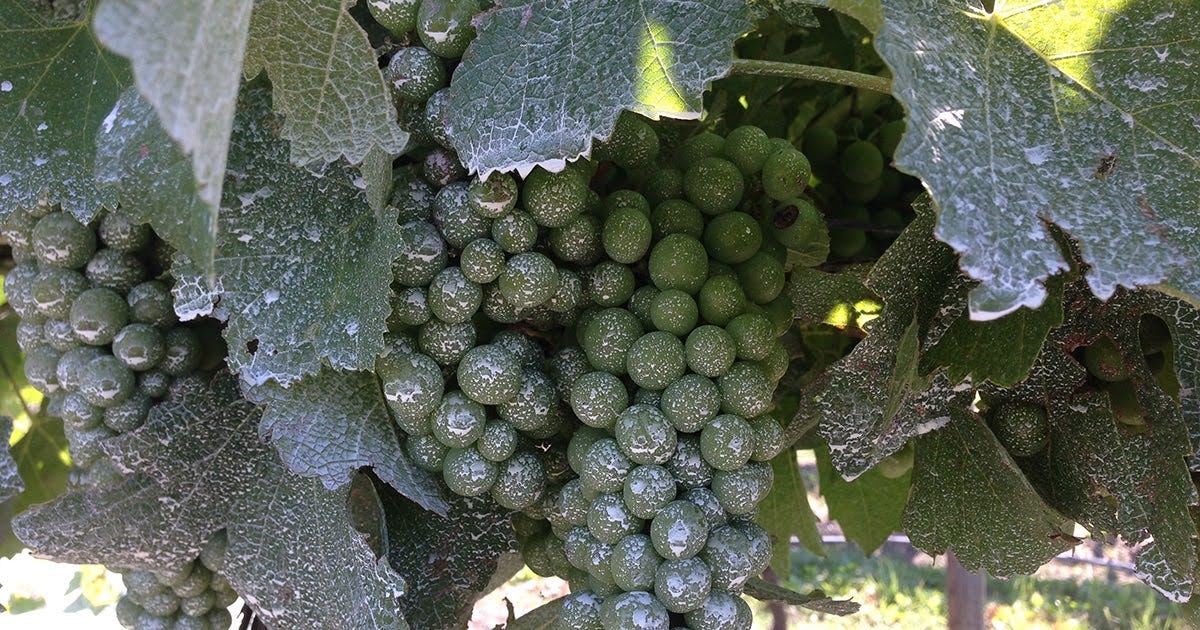
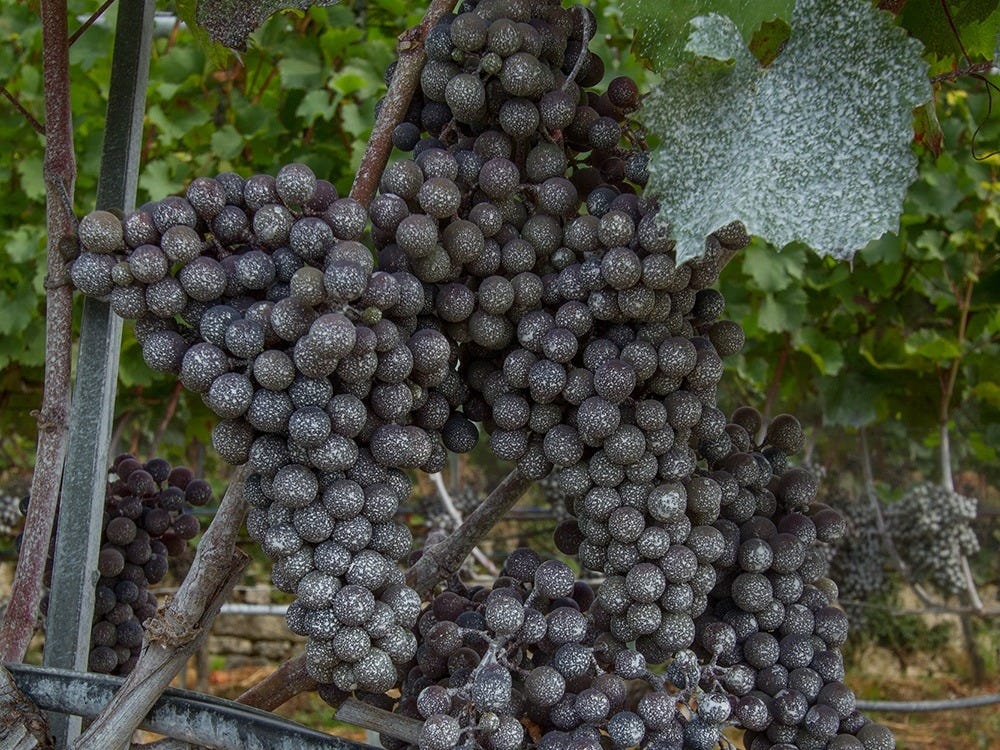
The second response is the one that fascinates me most, because it is the same clay that sits in the soil, repurposed as a shield. Growers spray their canopies with kaolin, a fine white clay applied as a suspension that dries into a pale, reflective film over leaves and fruit. The film works as a physical sunscreen, bouncing solar radiation away from the tissue underneath. The cooling effect is real and measurable. Commercial kaolin products report lowering canopy temperature by ten to fifteen degrees Fahrenheit and reducing sunburn on the fruit by around half, and the clay itself is inert and toxicologically harmless, with no negative effect on the finished wine.
Australian growers, working under some of the fiercest summer sun in the wine world, have relied on the same white-clay sunscreen for years to carry their vines through heatwaves, and I will come back to the wider science below. But watching a warm, tropical wine region reach for a mineral sunscreen is one of the clearest signs of how much the ground has shifted. Alongside these tactics, Indian growers are also experimenting with heat and disease tolerant grape varieties and eyeing cooler, higher sites, because in a country this warm the long-term challenge is not a single heatwave but the slow migration of the entire viable growing zone.
The science of the white clay
Kaolin particle film technology began in orchards, where growers used it to control pests and prevent sunburn on apples, and it has moved steadily into the vineyard as heat stress has worsened. When temperatures climb above roughly thirty-five degrees Celsius for several days, exposed berries dehydrate and scorch, and leaf temperatures can climb even higher than the surrounding air, shutting down the vine’s own cooling mechanisms. A reflective clay layer intercepts some of that radiation before it can do damage.
Research from central Italy to the Mediterranean coast to the Columbia Basin in the United States and the Hunter Valley in Australia has tested kaolin on heat-stressed vines, generally finding that it lowers berry temperature, reduces sunburn losses and helps preserve both yield and fruit chemistry during heat events, even if it does not eliminate damage entirely. Recent work in India has extended the same principle to other heat-sensitive crops in arid conditions, confirming its role as a low-cost tool for thermal shielding.
Spain and the Mediterranean: cooling the soil from the ground up
In the vast, dry vineyards of central Spain, which cover more grapevine surface than any country on earth, some of the most effective work is done on the soil itself. Growers spread thick mulches of rice straw between the rows, using a by-product of the rice harvest that would otherwise be burned, sending carbon needlessly into the atmosphere. Laid across the ground, the straw does three quiet, valuable things at once. It shades the soil from direct sun and keeps it cooler, it cushions the surface against heavy raindrops that would otherwise compact and seal the earth, and it slows evaporation so that scarce water stays in the ground for longer.
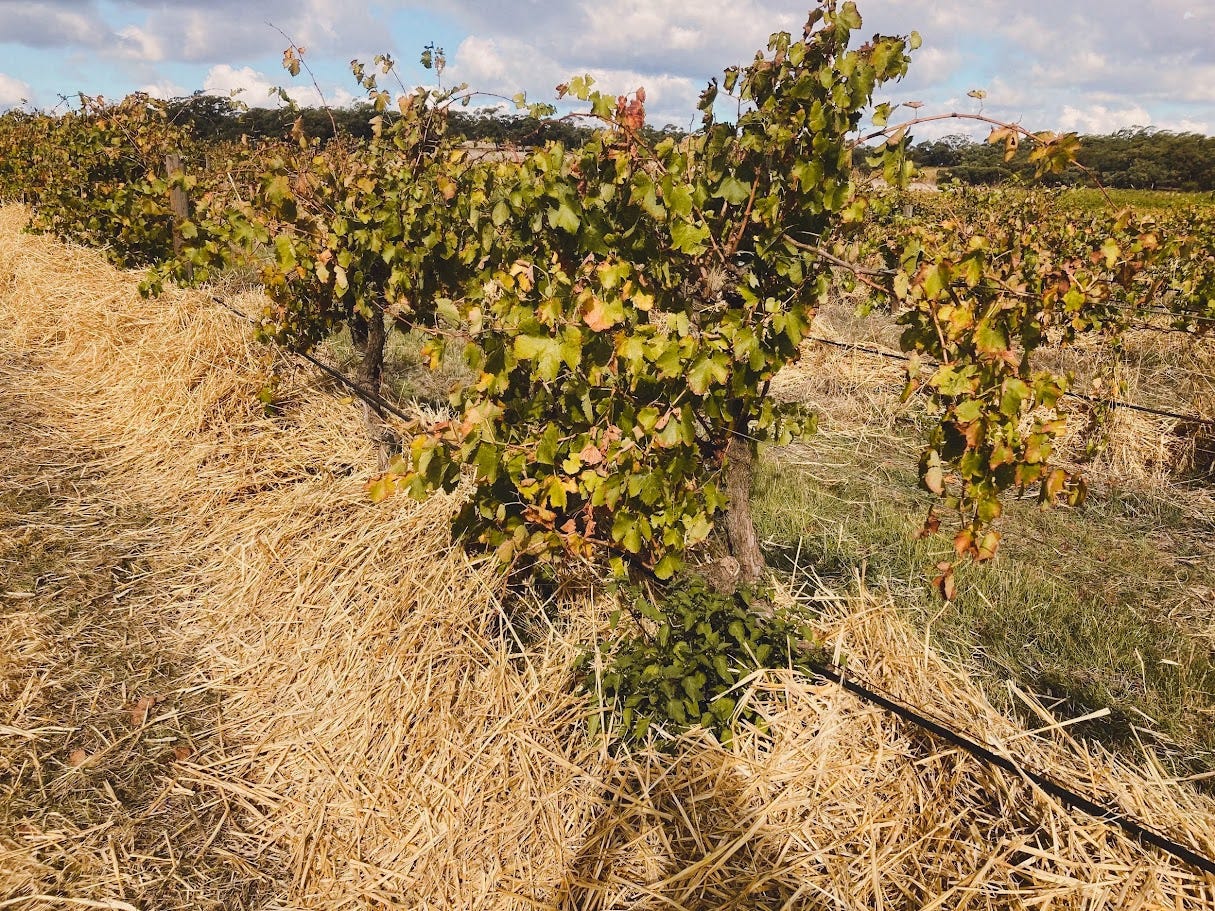
A multi-year trial at the Polytechnic University of Valencia measured the effects precisely, finding that rice-straw mulch reduced soil bulk density, improved water retention and raised soil organic carbon by close to a quarter compared with bare soil. Cover crops, sown between the rows to shade and feed the ground, work along similar lines. Techniques like these rarely make for dramatic photographs, but in a region defined by drought they may matter more than any gadget, and they carry the added grace of turning agricultural waste into vineyard resilience.
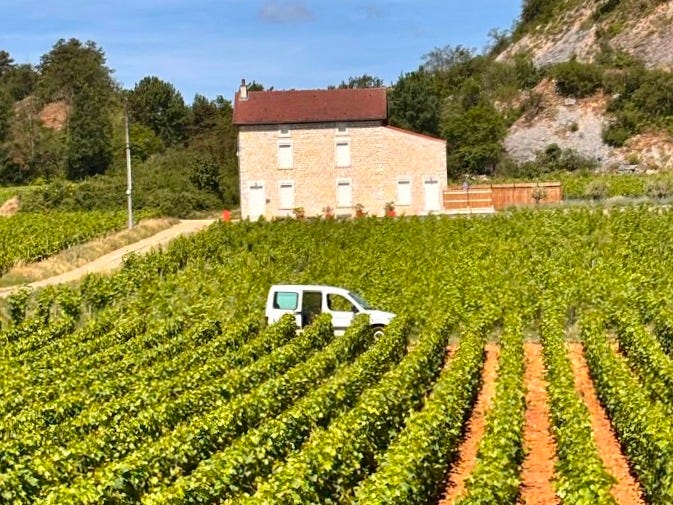
Hail: nets in Mendoza,rockets in Bourgogne (Burgundy)
If heat and rain are slow, grinding threats, hail is the sudden one, capable of stripping a vineyard bare in a couple of violent minutes.
In Mendoza, Argentina, a high-altitude desert where hail can fall as large as baseballs and damages close to a third of the region’s vineyards in a given year, the answer is physical armour. Growers drape their most valued plots in fine nets stretched over the vines, sheer enough to let light and air through but strong enough to break the fall of the ice. The nets have become such a fixture that other hail-prone regions now openly seek out Argentine expertise when their own weather turns violent.
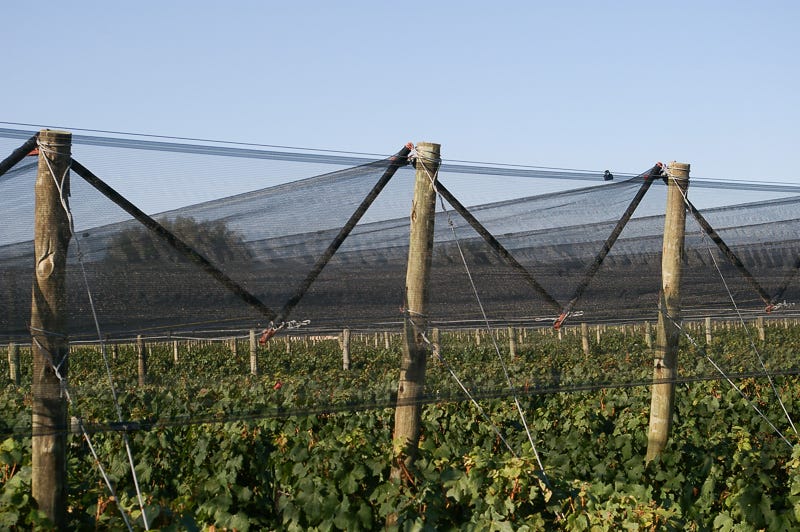
Bourgogne (Burgundy) has taken a very different path, one aimed at the storm rather than the vines. After a run of devastating hail years, the region built a network of ground generators that seed threatening clouds with silver iodide, a technique intended to make the hailstones form smaller and fall more gently. That system now covers almost the whole of the Bourgogne (Burgundy) vineyard, and more recently growers here have begun trialling the Argentine approach as well, testing hail nets over a set of plots to see how they affect ripening and the finished wine. It is a telling detail as even a region as proud and traditional as this one is now borrowing ideas from the other side of the world.
Shade nets and the art of dimming the sun
As heatwaves lengthen, a further idea is gaining ground across the Mediterranean and beyond: simply putting the vines in partial shade. Shade netting stretched over the rows softens the fierce afternoon light and lowers the temperature the fruit experiences, and researchers are increasingly testing it head to head with kaolin over multiple seasons to understand which approach best protects the fruit without compromising ripeness.
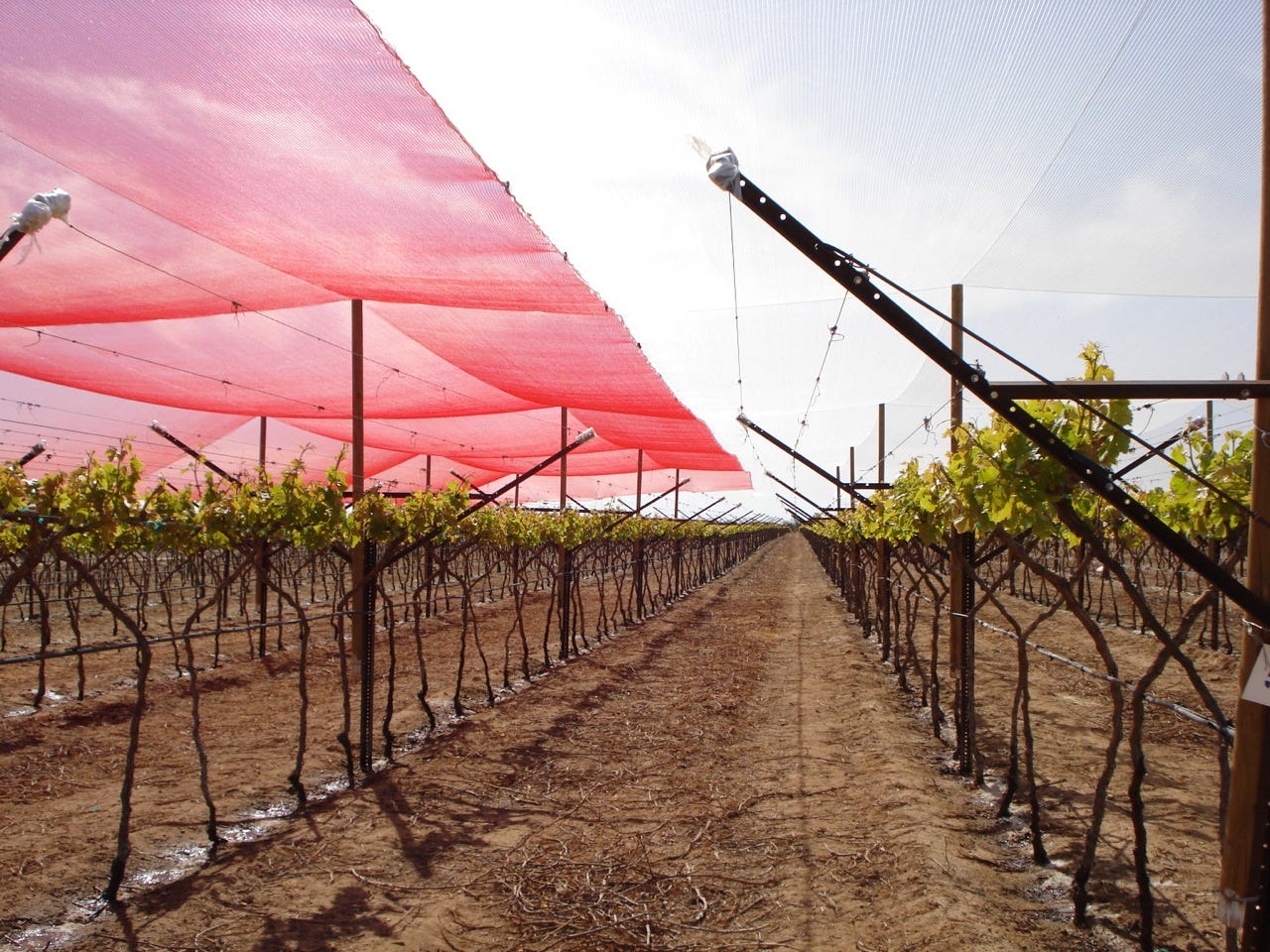
The difficulty is that grapes still need sunlight to develop sugar, colour and flavour, so the goal is not to block the sun but to dim it by precisely the right amount. Getting that balance wrong trades sunburn for greenness. Getting it right may become standard practice in the hottest regions within a decade, and it is already changing the way a modern vineyard looks from the road.
Who is teaching whom
The most striking thing about this global patchwork of solutions is not any single technique but the fact that almost none of it used to be necessary. A generation ago most of these vineyards trusted the seasons. Now they staple paper, spray clay, mulch the soil, seed the sky and stitch nets across the hills, all to bring in a crop that once arrived on its own. There is loss in that, and it should be named honestly rather than dressed up as innovation.
There is also, quietly, a kind of justice in it. The patient, low-technology, hand-intensive methods of regions like Japan and India were long treated as quaint at best and backward at worst by the traditional centres of fine wine. Those same methods are now studied as models, and even the most storied European regions are borrowing tools from South America and Asia. Climate change is a brutal leveller, but in the vineyard it is also forcing the wine world to do something it has historically been reluctant to do, which is to accept that good ideas have never belonged to only one part of the map. The grape has always travelled. It turns out the knowledge does too.
Sources and Further reading
The Drinks Business, “How to cultivate vines in Japan,” and the FAO Yamanashi fruit cultivation report, on Japanese paper hats, rain-shelter cultivation and pergola training, with the FAO’s “Grape Production in Japan” and Grow Organic on soil management and rice husk drainage; The Quint and Mongabay India, on heat, unseasonal rain and adaptation in Nashik; Surround WP technical data, the BIO Web of Conferences study on kaolin and heat stress in Pinot Noir, OENO One and ScienceDirect papers on kaolin particle film, Wine Australia’s Hunter Valley sunscreen trial, and Pallotti and colleagues (2025) on anti-hail shading nets and kaolin in Mediterranean vineyards; the 2023 Agronomy study from the Polytechnic University of Valencia on rice-straw mulch; The Wine Society Argentina guide, reporting on Mendoza hail nets and the Zuccardi family, and BKWine Magazine on hail protection in Bourgogne (Burgundy) and Argentina; and ScienceDirect’s review of viticulture in Argentina under extreme weather.
 The Winedian Girl
Leave a comment