

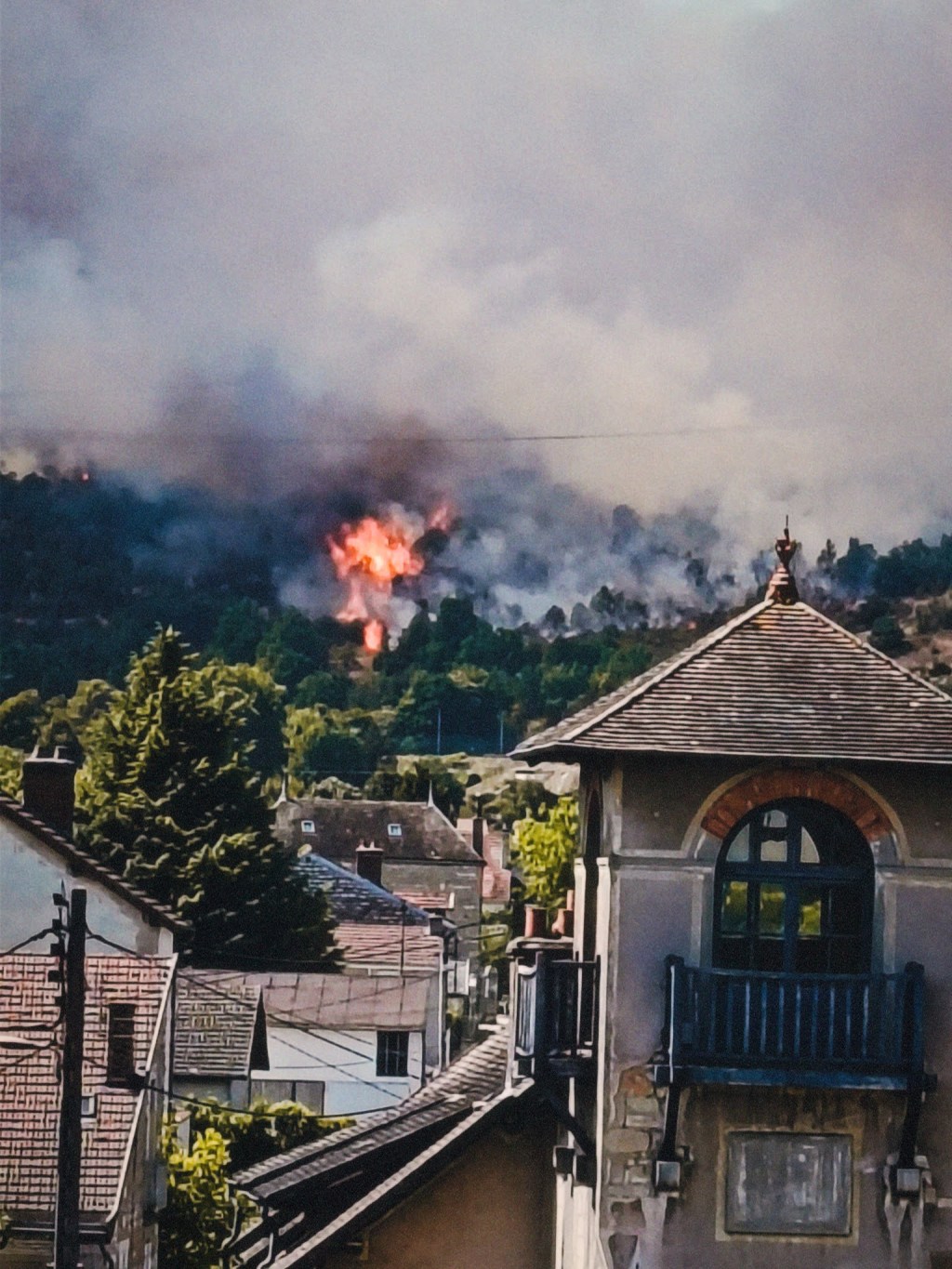
Living in Beaune, means I spend a great deal of my life watching the weather the way other people watch the news, with dread and a slightly obsessive attention to detail. This year the weather has been the news. If you have followed my Instagram feed through the spring and summer of 2026, you already know the vines here have been through something close to a full biblical set of trials. But I want to lay the whole year out in order, with the numbers and the sources, because the story only makes sense when you see the sequence.

The spring started with frost. A cold snap swept across France in late March, bringing frost and even snow to vineyards, and by early April the real damage arrived. The frost event that began around the 5th of April and lasted up to three days hit growers from Bourgogne (Burgundy) down to the south, and the Côte de Beaune, was among the areas struck hardest, with losses reported as high as 80% in some sectors. In Chablis, Didier Séguier of Domaine William Fèvre described enduring twelve nights of frost in the three weeks after budbreak, and estimated up to a third of the harvest affected. This is a domaine that has already spent something in the order of 80,000 US dollars per hectare installing electric warming cables in the vines, because the old romance of the candles, the bougies antigel flickering across a frozen slope at three in the morning, is no longer enough.
And here is the cruel mechanism that people outside viticulture miss. Warming does not abolish frost, rather makes it makes it worse. Mild winters and early springs push the vine to budbreak earlier, so the tender new growth is already out and vulnerable when the cold snaps back. The warmer the world gets, the more exposed the vine becomes to exactly the frost we assume warming should have banished. That paradox is now the defining anxiety of every spring in Bourgogne (Burgundy).

The vines had barely regrouped when the heat arrived, and it arrived early. France was gripped by an unusually early heatwave in May, the kind of thing that used to be a July event and is now casually turning up before. Spoiler Alert!!! It was a preview. What came next was the main feature.
But before the great heatwave, the sky decided to throw hail at us specifically. In mid-June, violent storms rolled through the Côte, and the damage clustered with horrible precision around Beaune, Pommard and Savigny-lès-Beaune. Reports circulated of the well-regarded Les Teurons vineyard in Beaune losing as much as 70 percent of its crop. One vigneron near here described losing twenty to thirty percent of a crop in five minutes. Frost is a slow, sleepless war and Hail is an execution. A few minutes of ice the size of a table tennis ball and a year of work is simply gone. The hail kept coming through the month, striking the Côte de Brouilly on the 28th of June as well.

Then, from the 17th to the 30th of June, France endured the heatwave that will define this summer in the record books. According to Météo-France, it was the hottest June the country has recorded since measurements began in 1947. The 24th of June became, by nationwide average temperature across day and night, the single hottest day ever recorded in France, with the country averaging around 30°C around the clock and beating the previous all-day record set in July 2019. The individual peaks were the stuff of nightmares: 44.3°C at Pissos on the 23rd, Bordeaux over 41°C, and Paris pushing past 40°C on both the 24th and 25th, a threshold the capital has crossed only a handful of times in its records. Here in Bourgogne (Burgundy), June temperatures ran around 4.4°C above the thirty year average, alongside one of the most severe water deficits growers have ever tracked. The human cost was staggering and is too often left out of the wine conversation: this heatwave is associated with more than 5,000 deaths in France.

Heat plus drought plus wind is a recipe, and in July France cooked. A third heatwave arrived at the start of the month, and with it the fires. Blazes broke out across the south, in the Aude and Hérault near the Spanish border, around Marseille, in the Gard, in the Pyrénées-Orientales, and then, devastatingly, in the Gironde and the Landes. By late July the interior minister put the area burned nationwide at around 115,000 hectares, making this France’s worst wildfire season on record, and it arrived before the traditional late summer fire peak had even begun. More than 220,000 people were evacuated from the Gironde region alone, and a fire even tore through part of the Fontainebleau forest, on the doorstep of Paris. The Prime Minister, Sébastien Lecornu, said plainly what the science has been saying for years, that climate change has pulled the fire season forward into a longer, hungrier window, like thanks?

And then, briefly, around the middle of July, storm systems pushed the heat back and brought rain, along with the usual sting in the tail, more hail and violent gusts embedded in the storms. On the evening of Wednesday the 15th of July, after a day of punishing heat, a supercell storm tore across the Morvan and slammed into Dijon and the wider Côte-d’Or, dumping hailstones up to around 5cm across, some the size of golf balls, alongside roughly 16,000 lightning strikes from a storm cell about fifty kilometres wide. It shredded trees, smashed windscreens and roofs, and left streets in a Bourgogne (Burgundy) heatwave carpeted in ice, and the damage was serious enough that Dijon and several neighbouring communes moved to request recognition as a natural disaster, an état de catastrophe naturelle. This is the exact mechanism the whole year keeps demonstrating: superheated air near the ground meeting colder, unstable air above it, and detonating. For a few days after, temperatures in the north slipped back under 30°C and the country exhaled.

STOP STOP!!!! It does not end there.. By the end of July, forecasters were already warning of a fourth heatwave building into August, after storms swept through first. Three nationwide heatwaves in a single month and a half is, in the words of French forecasters, a pace never before seen in the country, and a fourth was queuing up behind them before we had caught our breath.

Here is why I refuse to put all this under “unusual weather” and move on. A freak year is a freak year.!!! Frost is getting more damaging because warm weather pushes the vine out early. Hail and supercell storms are arriving with more violence. Heatwaves are no longer the singular events of my childhood but a season of them, stacked back to back, each one drier and more dangerous than the industry’s models were built to expect. The fires come earlier and burn more. And through all of it, the people who make the wine you drink are standing in their vineyards at dawn, lighting candles against the frost and praying the hail holds off, working a calendar that climate change is rewriting under their feet in real time.
I love this region with my whole chest, and I am telling you honestly that the vigneron’s year is becoming an act of endurance. The next time you open a bottle from a difficult vintage, know that “difficult” is doing an enormous amount of quiet, exhausting work babe.
Sources
Météo-France, via Scientific American and Al Jazeera, on the June 2026 heatwave (17 to 30 June), France’s hottest June since 1947, the 24 June nationwide record, and the 44.3°C peak at Pissos on 23 June.
The Local France, on France’s unusually early May heatwave and the sequence of nationwide heatwaves, including the figure of more than 5,000 deaths in the June heatwave and the forecast fourth heatwave into August.
The Drinks Business and The Buyer, on the April frost event, Côte de Beaune losses, and Domaine William Fèvre’s twelve nights of frost and electric warming cables.
Wine-Searcher and Burgundy Report, on the June hail around Beaune, Pommard, Savigny-lès-Beaune and the Côte de Brouilly, and on Bourgogne (Burgundy) June temperatures running around 4.4°C above the thirty year average.
France 24, RFI and the French Interior Ministry (Laurent Nunez), on the 2026 wildfire season, the roughly 115,000 hectares burned, the Gironde evacuations and the Fontainebleau fire; Prime Minister Sébastien Lecornu on climate change lengthening the fire season.
Copernicus Climate Change Service (C3S) and the WMO, on western Europe’s hottest June on record.
Sortiraparis and Connexion France, on the mid-July storms, the brief cooling, and the return of extreme heat.
France 3 Bourgogne-Franche-Comté (franceinfo) and Dijon Actualités, on the supercell hailstorm that struck Dijon and the Côte-d’Or on the evening of 15 July 2026, with hailstones up to around 5cm, roughly 16,000 lightning strikes, and the moves by Dijon and neighbouring communes to request recognition as a natural disaster (état de catastrophe naturelle).
 The Winedian Girl
Leave a comment